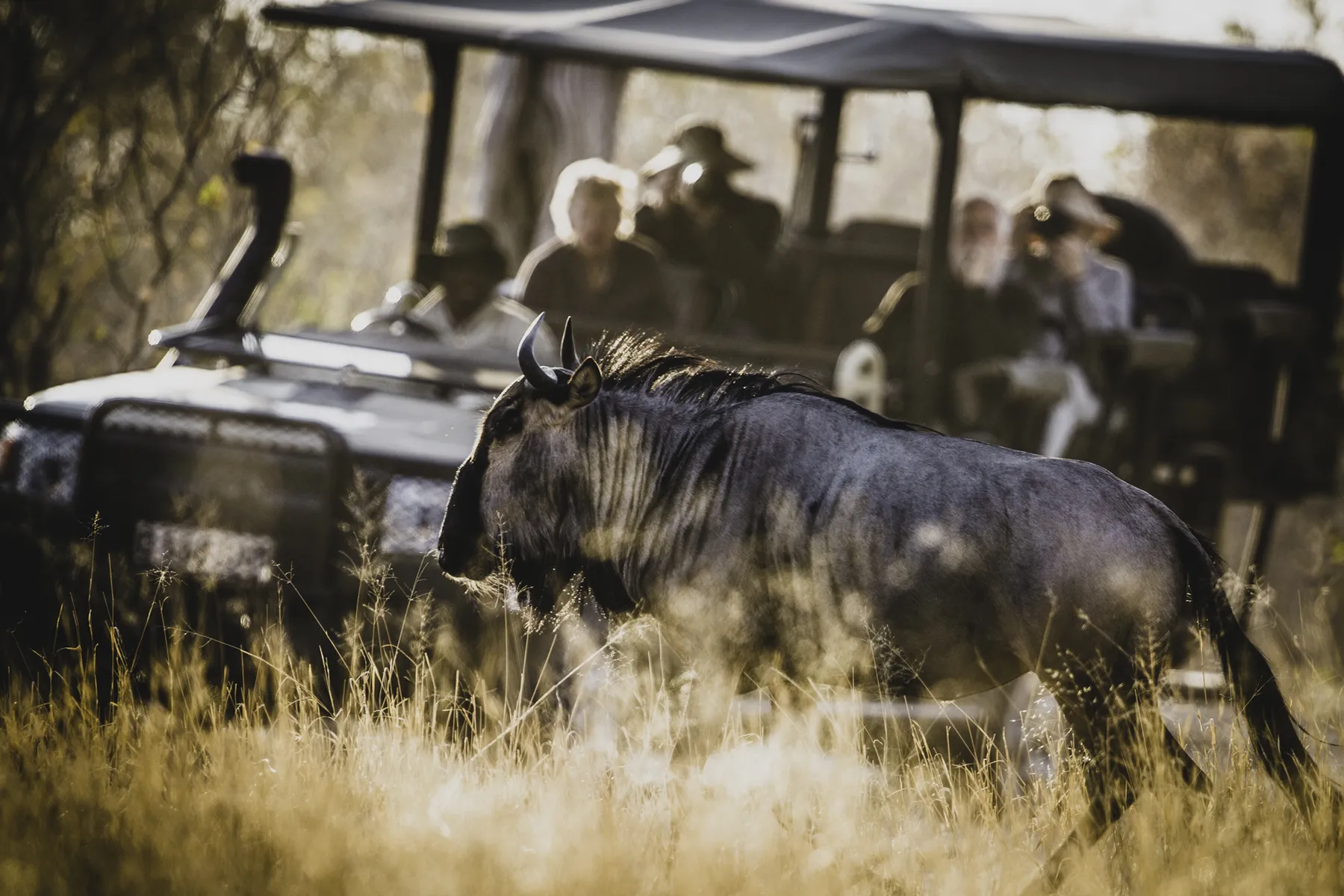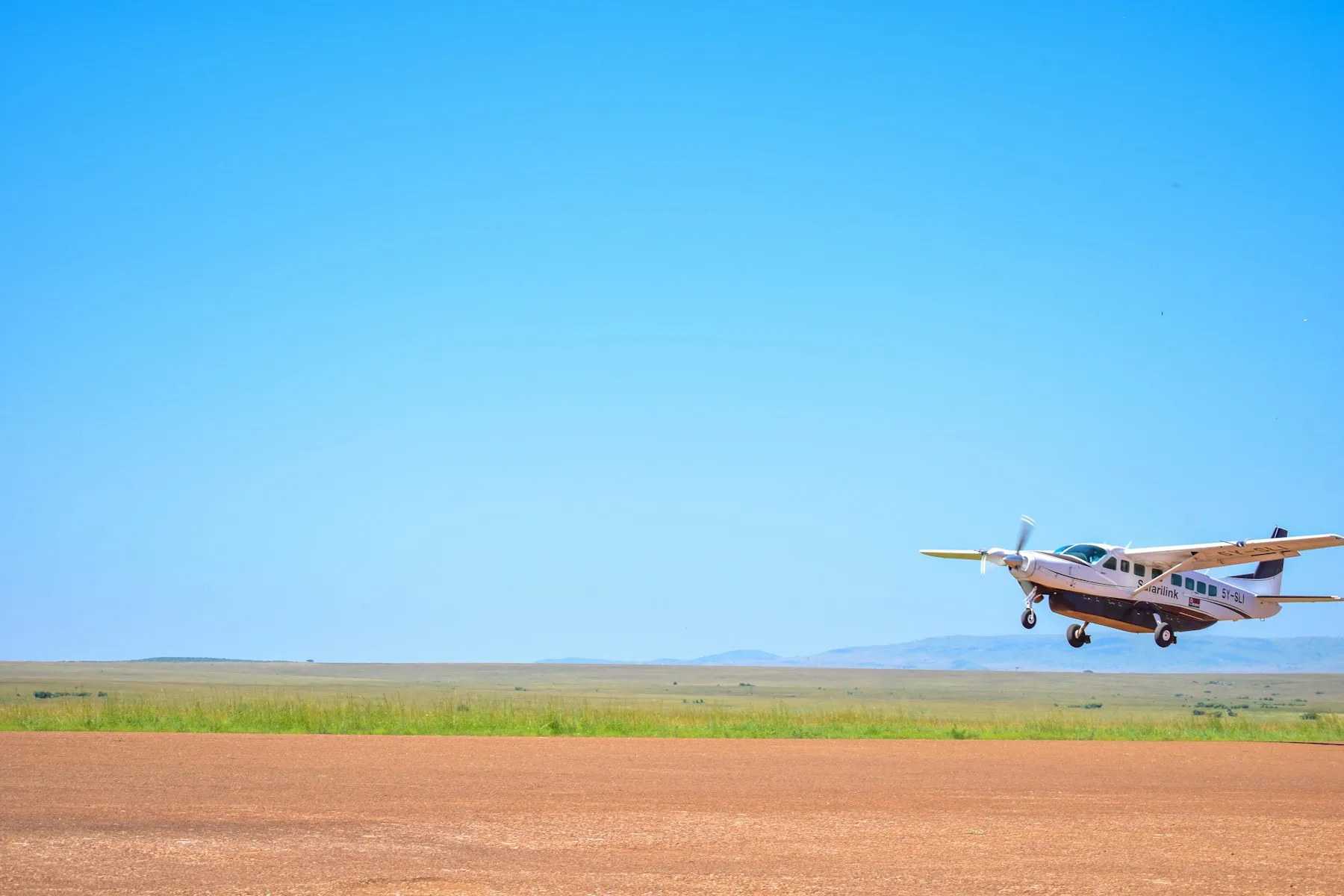
A fly-in safari replaces the long drives between parks with short flights in small aircraft. Then you land on a dirt airstrip, your guide is waiting with the vehicle, and the drive to camp becomes the first game drive. It is also how most travelers reach the Okavango Delta and the remote corners of the Serengeti and the Maasai Mara, and it changes what a shorter trip can include. This guide explains how the flights work, what the airlines allow you to carry, and when flying is worth the extra cost.
What is a fly-in safari?
On a fly-in safari, light aircraft link your camps rather than roads. Scheduled safari airlines run daily circuits from hubs such as Nairobi’s Wilson Airport, Arusha and Maun, landing at airstrips inside or beside the parks. Also, private charters fly the same strips on your own timing. Between flights you are on the ground with a guide and vehicle, exactly as on any other safari. In fact, many itineraries mix the two: a road journey where the scenery deserves it, a flight where the road would only cost you a day. Our safari map shows how the main parks connect.
Where a fly-in safari makes sense
| Where | Usual hub | Typical flight | Why fly |
|---|---|---|---|
| Maasai Mara, Kenya | Wilson Airport, Nairobi | 45 to 60 minutes | Morning arrivals can be in camp for lunch instead of spending the day on the road |
| Serengeti, Tanzania | Arusha, after landing at Kilimanjaro | One to two hours | The northern and western Serengeti are a long way from the rest of the circuit by road |
| Okavango Delta, Botswana | Maun | 15 to 30 minutes between camps | Many Delta camps sit on islands in the floodwater and are reached by air |
| Sabi Sand and Greater Kruger, South Africa | Johannesburg | About an hour | Optional: the reserves also work well by road |
| Namibia | Windhoek | Around 70 minutes between regions | Distances are enormous, and the flights cross the dunes |
| Serengeti to Zanzibar | Serengeti airstrips | About 1 hour 40 minutes to 3 hours or more, depending on routing | Ends a safari on the beach without returning to the city |
On a Kenya safari, flights to the Mara and the northern conservancies leave from Wilson Airport, a 30 to 45 minute drive across Nairobi from the international airport, so we build that transfer into your first day. In northern Tanzania the classic Tarangire, Ngorongoro and central Serengeti route works well by road. Still, the flight earns its place for the far north, the west and the hop to the coast. The northern Serengeti guide and Serengeti vs Masai Mara explain the geography. In Botswana flying is not optional for most of the Delta, which is part of why its camps feel so remote.
How the flights work
Scheduled or private charter
Scheduled safari flights sell individual seats and run a circuit, so your plane may land at other airstrips on the way to yours. That is part of the experience, with low-level views of the plains, but it means a 40-minute hop can take longer. A private charter flies directly, departs when you are ready, and suits families, small groups and anyone short on time. Of course, we tell you which one each sector uses in your proposal.
The aircraft
The workhorse is the single-engine Cessna Caravan; Mack Air in Botswana describes its Grand Caravans as carrying up to 12 passengers out of small airstrips. Seating is close, and there is also no cabin crew. Midday flights over hot ground are often bumpy, and the airline itself suggests anti-nausea tablets if you are prone to motion sickness. The pilot has the final word on load and conditions. That is why airlines enforce weight limits at check-in.
At the airstrip
Meanwhile, bush airstrips are usually a graded dirt runway, a windsock and sometimes a small shelter. Then your guide meets the plane, loads your bags and often stops for wildlife on the way to camp. On departure day the flight schedule sets the timing, so we plan the last game drive around it.
Luggage limits on safari flights
In fact, this is the rule that surprises most first-time travelers. The limit covers everything you carry, including hand luggage, cameras and laptops, and the bag itself needs to be soft so it fits the aircraft’s small luggage pod. These are the rules the airlines themselves publish for the routes we use most:
| Airline and route | Allowance per person | Hand luggage | Bags |
|---|---|---|---|
| Coastal Aviation, Tanzania | 15 kg (33 lb) | Included in the 15 kg | Soft bags strongly recommended; duffel about 40 x 40 x 80 cm |
| Auric Air, Tanzania | 20 kg (44 lb) | Included in the 20 kg | Suitcases accepted, soft bags recommended; maximum 90 x 65 x 35 cm |
| Miracle Air, Tanzania (scheduled flights) | Up to 25 kg (55 lb); 20 kg on some flights | 5 kg, within the 25 kg | Soft bags |
| Safarilink, Kenya | 15 kg on safari routes; 20 kg to Zanzibar and the coast | Included | Soft bags |
| Mack Air, Botswana from Maun | 20 kg (44 lb) | Included | Soft bags preferred; maximum 30 x 35 x 70 cm |
Extra allowance and packing
- Need more? Coastal Aviation offers an XL seat with a 30 kg allowance, subject to availability. Similarly, Safarilink sells a freight seat at the adult fare that carries an extra 75 kg. In addition, Auric Air sells pre-booked 10 kg blocks, USD 60 each on safari routes. You have to book all of these in advance; Coastal warns that excess bags arriving without a reservation may follow on a later flight.
- Photographers: long lenses count toward the limit. Our photo safari guide covers what to bring and when an extra seat is worth it.
- Packing: camps offer laundry, so a week of clothes is enough for a longer trip. The safari packing list works within these limits.
- City or beach clothes: if your trip includes a city or beach stay, ask us early about leaving a second bag at the hub. However, what is possible depends on the airline and the route.
Is a fly-in safari worth it?
Flying buys back time. For example, a six-hour transfer becomes a short flight and an extra game drive, and remote camps with very few other vehicles become possible on a trip of normal length. The trade-off is cost. We price every journey to your budget, and flights between parks are one of the largest optional costs alongside the camps and the season. As a guide, luxury safari camps and lodges typically run from about $1,000 to $3,000 or more per person per night, and flights come on top of that. A fly-in itinerary therefore costs more than a drive-in one. Our safari cost guide explains what moves the total.
One caveat: at many fly-in camps, game drives are in the camp’s open vehicles and you may share them with other guests unless you reserve a private vehicle. Where it matters to you we reserve it and show it on the itinerary; our high-end private and exclusive-use safaris work that way from the start.
Who a fly-in safari suits
- Older travelers who would rather not spend hours on corrugated roads; see our guide to African safaris for older travelers.
- Families with young children, for whom a short hop is easier than a long drive; see safari with toddlers.
- Honeymooners who want remote camps and a beach finale in one trip; see our honeymoon safaris and bush and beach pairings.
- Anyone with a week or less, because flying is the only way to fit two very different areas into a short trip without losing days to the road.
It suits travelers less well if you love the road journey itself, travel with a lot of equipment, or are uneasy in small aircraft. In those cases northern Tanzania and the Greater Kruger work beautifully by road, and we plan accordingly.
Fly-in safari questions
What is a fly-in safari?
A fly-in safari links your camps by light aircraft instead of by road. Small scheduled or charter planes land on dirt airstrips inside or beside the parks, your guide meets you at the strip with the vehicle, and the drive to camp is often your first game drive. It is also the standard way to reach the Okavango Delta and the remote parts of the Serengeti and the Maasai Mara.
How much luggage can I take on a fly-in safari?
Usually 15 to 25 kg (33 to 55 lb) per person, including hand luggage and camera gear, in a soft bag. Coastal Aviation in Tanzania and Safarilink in Kenya allow 15 kg on most safari routes; Auric Air in Tanzania and Mack Air out of Maun in Botswana allow 20 kg; Miracle Air allows up to 25 kg on its scheduled Tanzania flights (20 kg on some). Also, you can usually buy extra allowance as an extra seat, which we arrange in advance.
Can I take a hard suitcase on a safari flight?
It is best not to. The luggage pods of light aircraft are small, so the airlines require or strongly recommend soft duffel bags without rigid frames. Coastal Aviation recommends a soft duffel of about 40 x 40 x 80 cm (16 x 16 x 31 in); Mack Air sets a maximum of 30 x 35 x 70 cm. Leave the suitcase at your city hotel if your trip ends there.
Is a fly-in safari more expensive?
Usually, yes. We price every journey to your budget, and light-aircraft flights are one of the largest optional costs alongside the camps and the season. As a guide, luxury safari camps and lodges typically run from about $1,000 to $3,000 or more per person per night, and flights between parks come on top of that. A fly-in itinerary therefore costs more than a drive-in one, and your proposal shows each flight as its own line.
Can young children fly on safari planes?
Yes. On light aircraft, children under two typically travel on a parent’s lap, and Safarilink notes that infants who do not pay for a seat have no baggage allowance of their own, so baby kit comes out of a parent’s limit. Short hops are usually easier on young children than long road transfers; our guide to a safari with toddlers covers the details.
Written and reviewed by NndeeAfrika · Published 7 October 2026