Written and reviewed by Evance & Jennifer, NndeeAfrika’s founders — Tanzanian-born, California-based · Reviewed August 2026 · Entry information checked August 2026 where shown
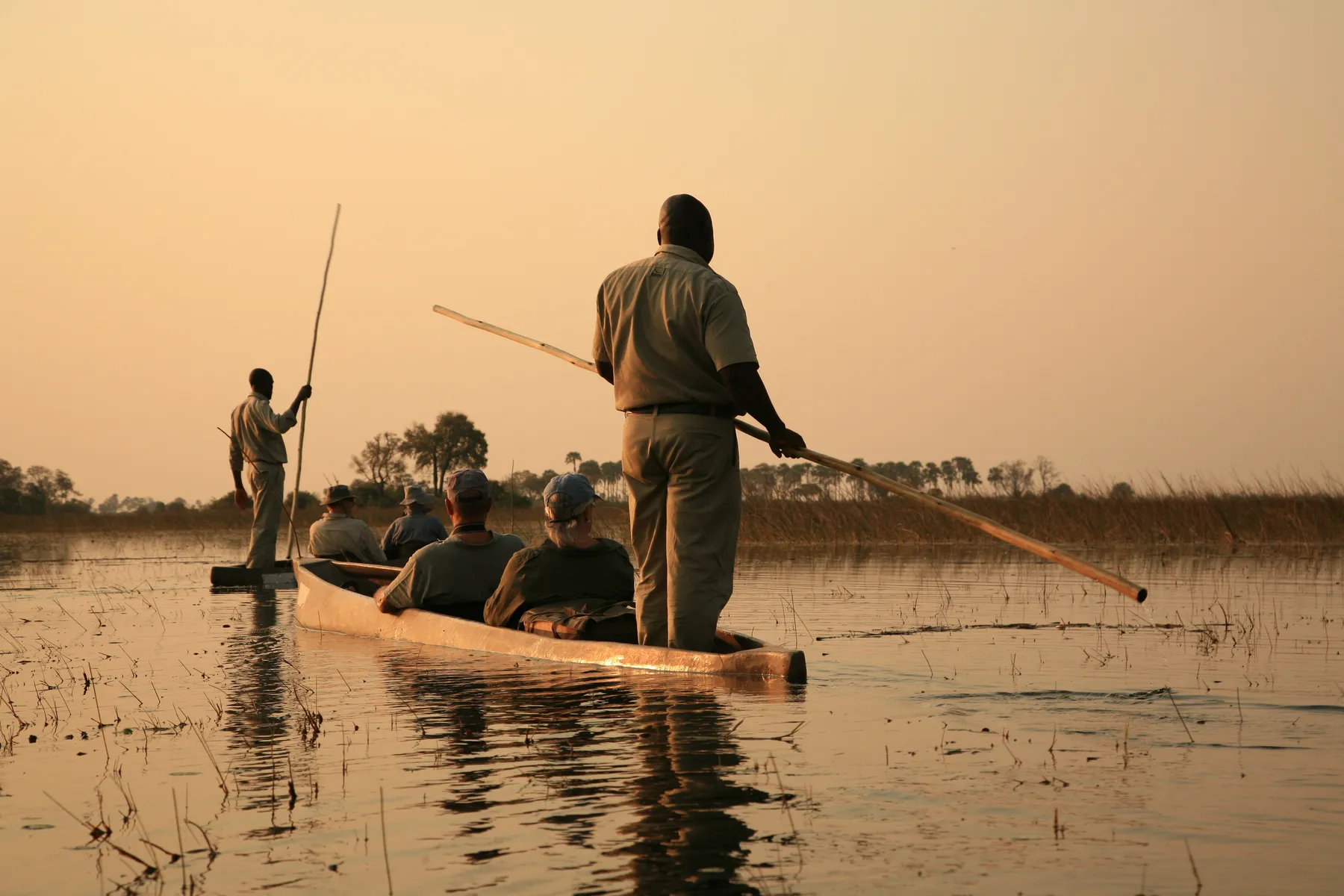
A luxury Botswana safari is about as exclusive as Africa gets. Botswana built its reputation on low-volume, high-value tourism, so its camps are intimate and its wilderness feels like yours alone — much of it explored by mokoro (dugout canoe) and on foot. Botswana sits at the heart of many of our luxury African safaris, often paired with Victoria Falls or Cape Town.
The Okavango Delta floods the Kalahari each year to create a labyrinth of channels and islands teeming with elephant, lion and wild dog, while Chobe holds one of the largest elephant populations on earth. Our guide to animals you can see on safari sets out which countries suit which species.
Highlights of Botswana
Okavango Delta
A UNESCO World Heritage wetland explored by mokoro, boat and 4x4.
Explore Okavango Delta →Chobe National Park
Vast elephant herds and superb riverfront game viewing.
Explore Chobe National Park →Moremi Game Reserve
One of Africa’s richest reserves for big cats and wild dog.
Explore Moremi Game Reserve →Kalahari & Makgadikgadi
Desert-adapted wildlife, meerkats and the vast salt pans.
Explore Kalahari & Makgadikgadi →Where you’ll stay in Botswana
Where you stay is selected privately around your journey. We recommend each camp, lodge or villa according to its location, season, guiding, privacy and suitability for the people traveling. Your carefully curated selection will be presented within your tailor-made itinerary.
Plan your private safariKnow before you go
The practical details we handle for you — flights, entry, health and money — summarized here so nothing surprises you. Requirements can change, so we confirm everything when you book. Planning a Botswana safari for seniors? Our senior safari guide explains which water camps and boat outings suit older travelers.
Fly to Maun or Kasane via Johannesburg — nonstops to Joburg from Atlanta and Newark take about 15–16 hours, then a two-hour connection. Most guests overnight in Joburg or Cape Town on the way in.
US passport holders enter Botswana visa-free for up to 90 days. Your passport needs six months' validity and a couple of blank pages.
The Okavango and Chobe are malaria areas — most doctors recommend prophylaxis. No yellow fever certificate is needed unless you arrive from an endemic country.
The pula is the currency, but lodges quote and accept US dollars and cards. Tipping is entirely at your discretion — most guests set aside about $20–25 per person per day for guides and camp staff.
What to do in Botswana
The experiences that define a Botswana safari — and that we build every route around.
Glide the Delta by mokoro
A poler stands at the stern and pushes you through lily channels in a dugout canoe — frogs ticking, elephants feeding on the islands. The quietest game viewing in Africa.
Okavango Delta
Jun–Oct, water levels peak
Chobe by boat at golden hour
Hundreds of elephants swim between islands as the sun drops. A private photographic boat puts you at water level, closer than any vehicle can get.
Chobe riverfront
Dry season, May–Oct
Meerkats and lost lakebeds in the Kalahari
Habituated meerkat colonies at dawn, black-maned lions by day, and quad rides across the Makgadikgadi salt pans under desert stars.
Makgadikgadi & Central Kalahari
Year-round; green season for zebra
Track wild dogs in the Linyanti
The private Linyanti and Selinda concessions hold some of Africa’s densest wild dog populations — with off-road driving and night drives no national park allows. These concessions are the natural place to explore Africa privately. Two favorite shapes: the Delta & Victoria Falls itinerary and the three-country Cape, Falls & Delta route.
Linyanti & Selinda
Jun–Oct, denning season
Best time to visit Botswana
Dry season and peak Delta flood — the best game viewing.
Green season — newborn wildlife, birding and lower rates.
In the green months rates ease at many of these camps, the plains empty of vehicles and the light turns dramatic. What each season gives, and what it trades, is set out in our Safari Planning Guide.
Planning & cost
Fully tailor-made — priced privately to your camps, season and travel style. No fixed packages.
Fly into Maun (MUB) or Kasane (BBK); light-aircraft transfers reach the camps.
Every journey is private and tailor-made — private guides and vehicles where specified, the finest lodges, and a specialist on call throughout.
Practical details,
in one place
Money, health, connectivity and packing work the same way on every safari we plan, so they live in one place rather than on every page.
Continue exploring
Victoria Falls
The largest sheet of falling water on earth — a natural wonder.
Explore → ExperienceOkavango Delta
An Okavango Delta safari explores Africa’s great water wilderness by mokoro and 4x4.
Explore → Southern AfricaSouth Africa
A South Africa safari pairs Big Five private reserves with Cape Town and the Winelands.
Explore → RegionSouthern Africa
The desert, the delta and the falls — Botswana, Namibia, Zambia, Zimbabwe and South Africa.
Explore →Botswana FAQs
Getting to Botswana — flights, visas and health
Current at the time of writing. We re-confirm every requirement for your exact routing before you travel — and we will tell you what to apply for, and when.
Let's design your Botswana journey.
A luxury Botswana safari is built around water, season and how far you want to be from anyone else.
Tell us how you like to travel and start with a complimentary consultation. When you are ready, a $500 USD planning fee covers your personalized itinerary and revisions, and is deducted from your booking deposit when you book.
Inquire now