Both are spotted. Both are fast. Both are cats. Beyond that they have almost nothing in common — different builds, different hunting strategies, different times of day, and very different odds of being seen. Here is how to tell them apart from a moving vehicle, which is where it usually matters.
The 10-second answer
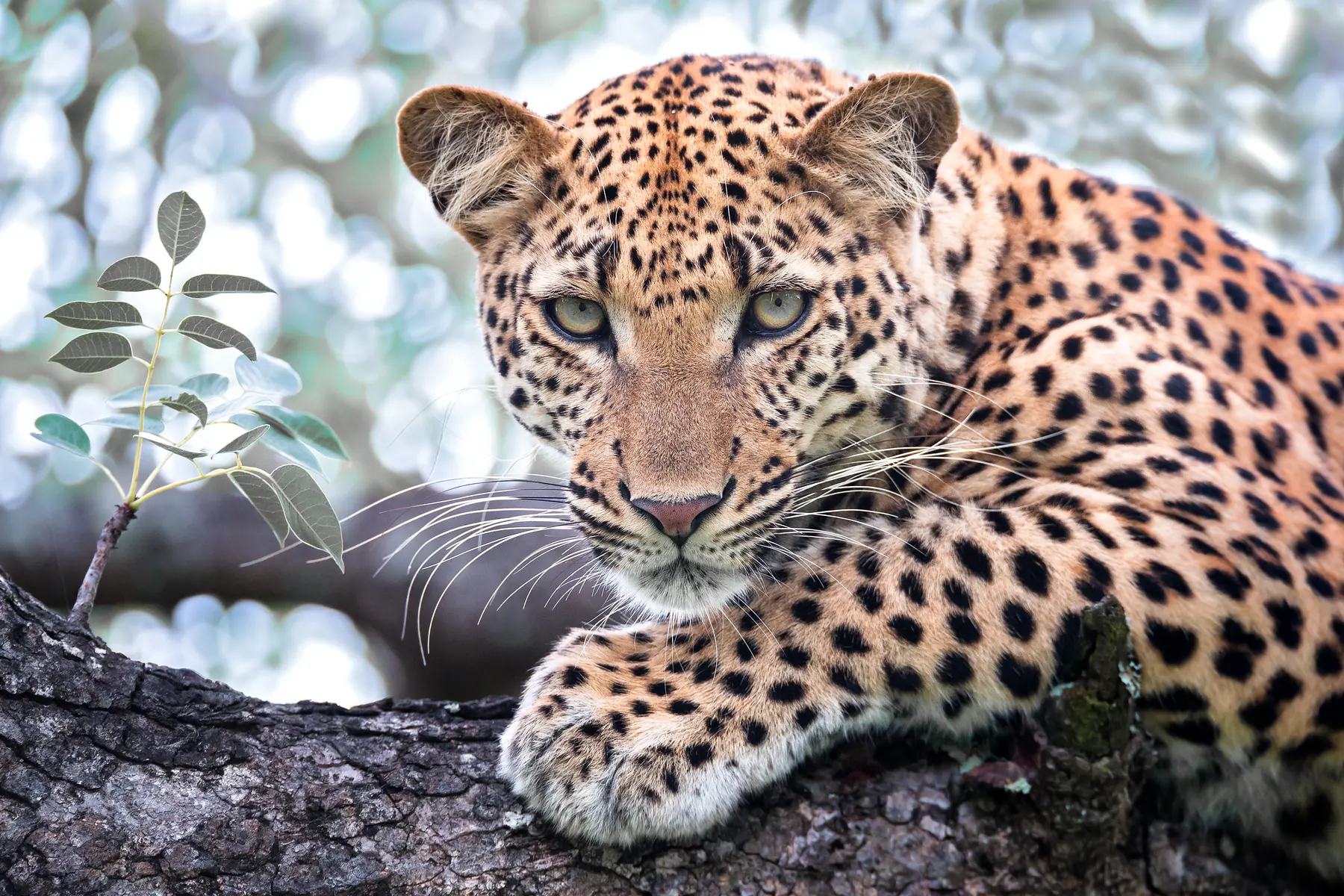
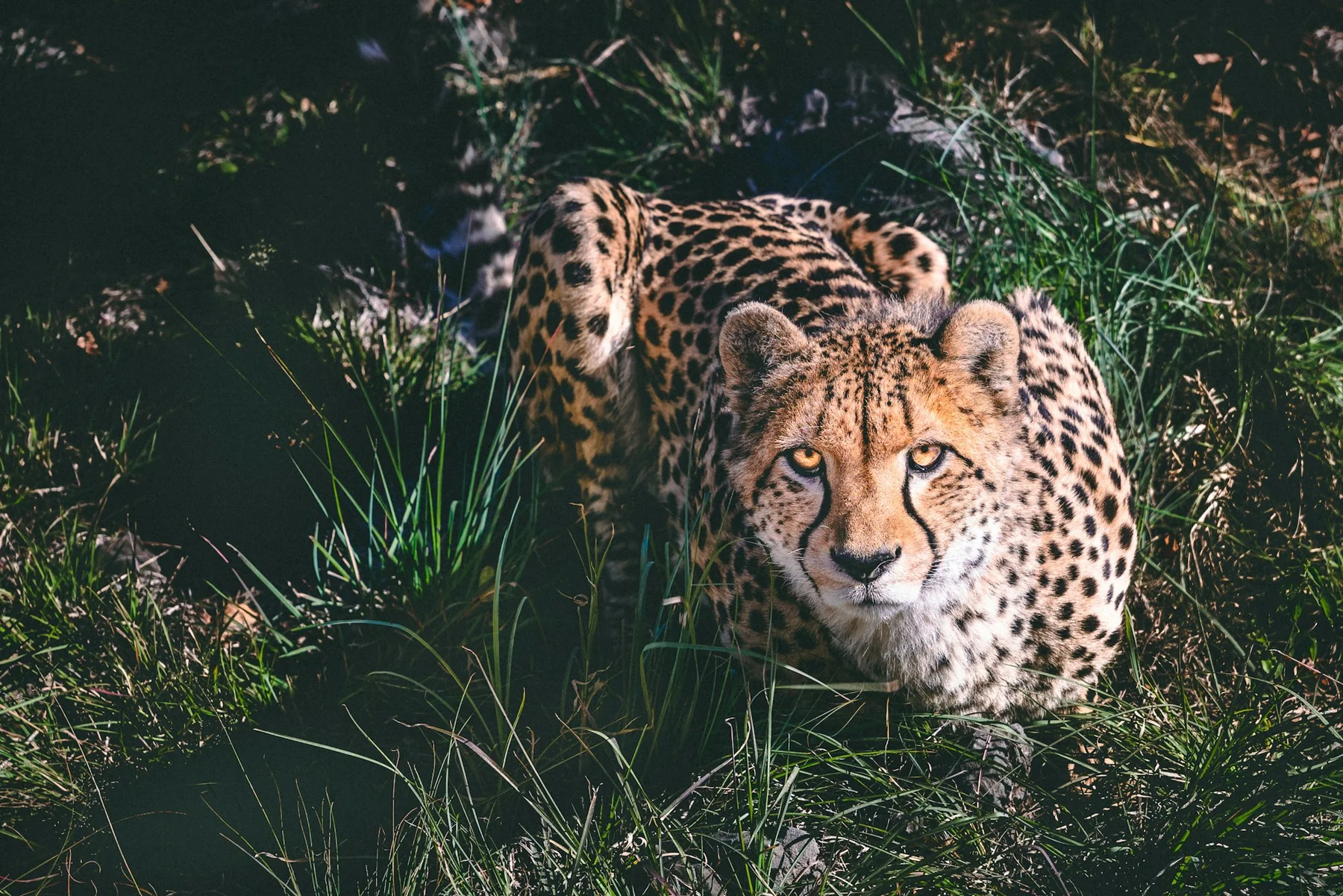
A cheetah has solid black spots, black tear marks running from the eye to the mouth, and a lean greyhound build. A leopard has rosettes rather than spots, no tear marks, and is heavily muscled with a much larger head. If the cat is in a tree, it is a leopard — cheetahs climb only low branches and termite mounds, and rarely with any grace.
| Cheetah | Leopard | |
|---|---|---|
| Markings | Solid round black spots | Rosettes — rings of spots, often with a darker center |
| Face | Black tear marks, eye to mouth | No tear marks; broad, heavy jaw |
| Build | Lean, deep chest, long thin legs | Muscular, short powerful legs, thick neck |
| Head | Small and rounded | Large and blocky |
| Tail | Long, flattened, ringed at the tip | Thick, white underside |
| Claws | Only semi-retractable — grip like running spikes | Fully retractable |
| Climbs trees | Rarely, and badly | Constantly — hoists kills into them |
| Active | Daylight, often mid-morning | Night and the edges of the day |
| Hunts by | Speed in the open | Stalking to within meters, then ambush |
| Voice | Chirps and purrs — cannot roar | A rasping call like a saw on wood |
Spots or rosettes
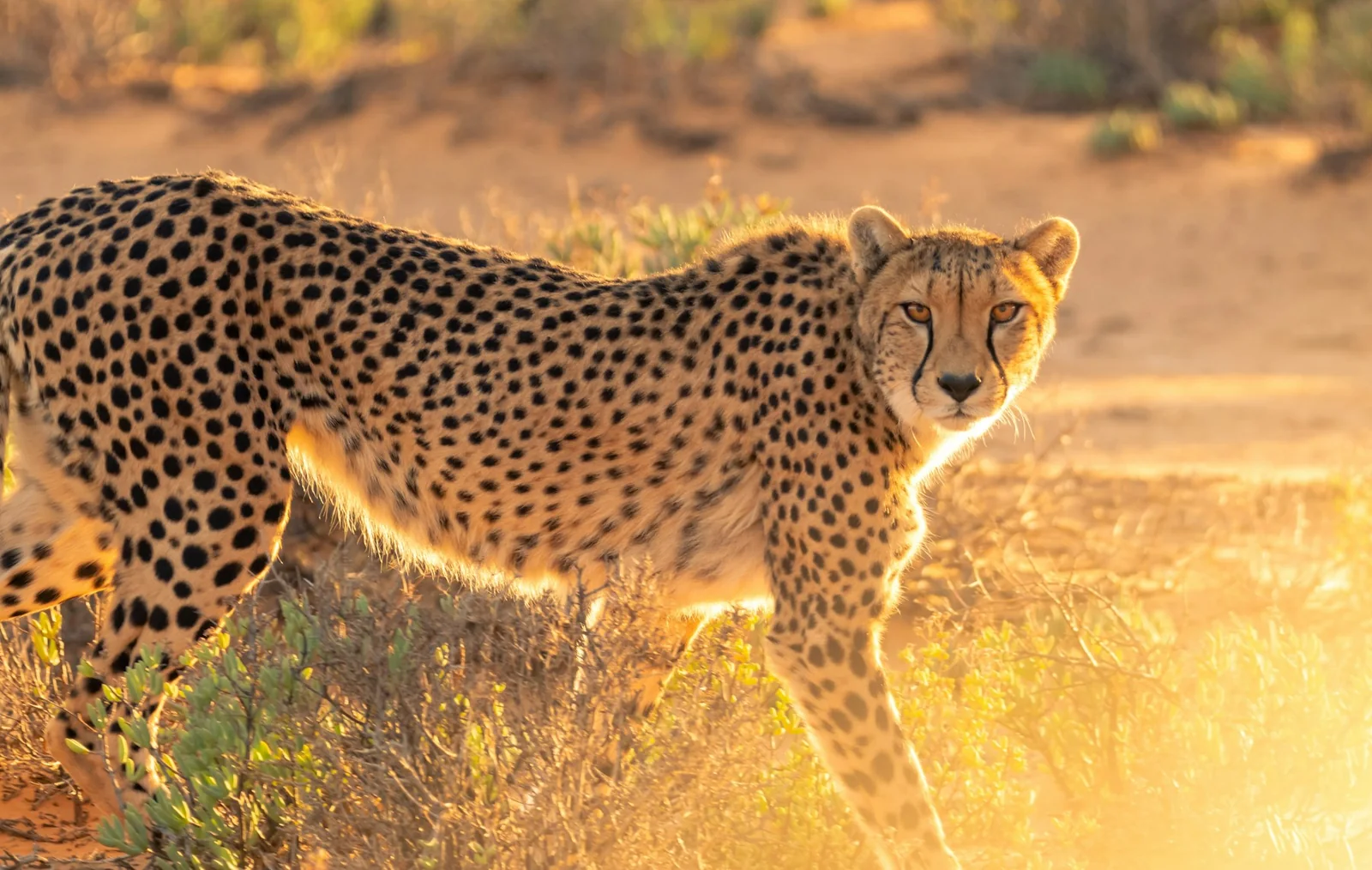
This is the tell that works at any distance where you can see the coat at all. A cheetah’s spots are solid — single round black dots, fairly evenly spaced, like ink flicked onto sand.
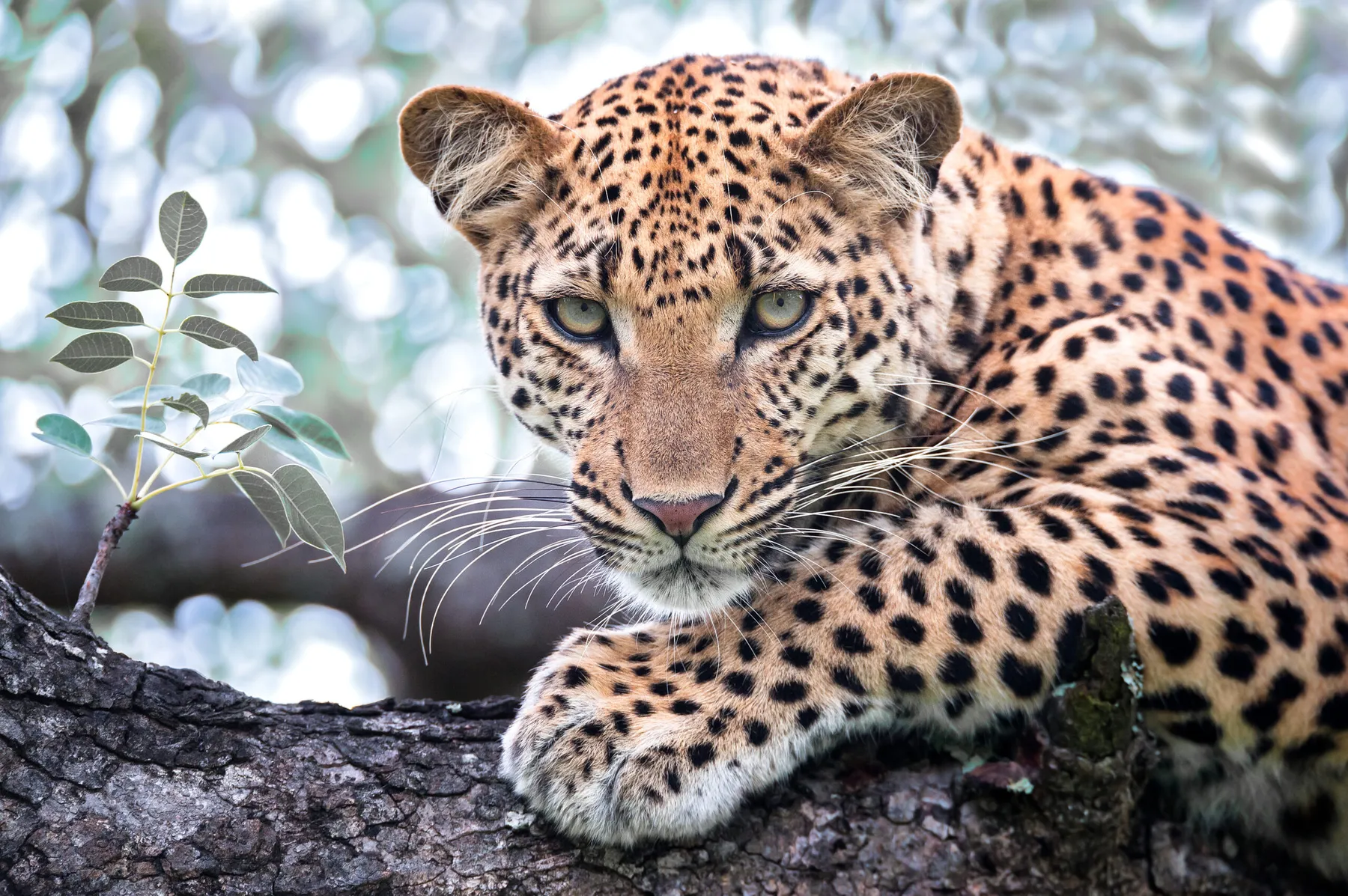
A leopard’s markings are rosettes — small spots arranged in broken rings, usually with a tawny center darker than the surrounding coat. Once you have seen the two side by side you will never confuse them again. Our leopard guide goes further into the species.
The tear marks
If the cat is facing you, this is faster than counting spots. A cheetah has two black lines running from the inner corner of each eye down to the mouth. They are thought to cut glare, in the way an athlete’s eye black does, which fits an animal that hunts in full daylight.
Leopards have nothing of the kind. A leopard’s face is broader, the muzzle heavier, and the expression — guides will tell you this and they are right — considerably less friendly.
Build: a greyhound and a boxer
A cheetah is built for one thing. Deep chest, narrow waist, small head, long light legs, and a spine that flexes like a spring. Everything about it is sacrificed to acceleration, and it is genuinely fragile — a cheetah cannot afford an injury, and it will abandon a kill rather than fight for it.
A leopard is the opposite animal. Shorter in the leg, far heavier through the shoulders and neck, and strong enough to carry a carcass heavier than itself vertically up a tree trunk. Pound for pound it is one of the strongest cats alive.
The other giveaway is the claws. A cheetah’s are only semi-retractable and stay partly exposed, giving traction like running spikes — you can often see them in the tracks. A leopard’s retract fully, which is how it keeps them sharp for climbing and holding prey.
How each one hunts — and when
Cheetahs hunt in daylight, often mid-morning, and they do it in the open where speed counts. The chase is brief and enormously costly, and the cat then needs to recover before it can eat — which is the window in which lions and hyenas take the kill from it. A large share of cheetah kills are lost this way.
Leopards work the edges of the day and the night. The strategy is stalking — closing to within a few meters before moving at all — followed by a short, violent rush. Then the carcass goes up a tree, out of reach of everything that would otherwise steal it. That single behaviour is why leopards thrive in country where cheetahs cannot.
For travelers this has a practical consequence. Cheetah sightings happen on a normal morning drive. Leopard sightings reward camps that can drive at night or have guides who know individual cats.
Where you will see each one
They overlap across much of eastern and southern Africa, but the places that reliably deliver each are not the same.
Best for cheetah
Open short-grass country. The southern Serengeti and Ndutu during calving season is the best cheetah viewing of the year — short grass, vast numbers of vulnerable prey, and nothing to block the view. The Maasai Mara and the Kalahari are also strong.
Best for leopard
Thicker bush and riverine forest. The Sabi Sand is the most reliable leopard country on the continent — generations of habituated cats and guides who know them individually. South Luangwa is outstanding and allows night drives; the Okavango is excellent too.
If you want both on one trip, a combination of open plains and dense bush does it — which is exactly how we build most first safaris.
Which is harder to find?
It depends where you are, which is not the answer people expect.
In the right reserve the leopard is easier. In the Sabi Sand most guests see leopard on more than one drive, because the cats are habituated and the guiding is built around them. Almost anywhere else, the leopard is the hardest of the Big Five by a distance — you can spend a fortnight in good leopard country and see nothing but tracks.
Cheetahs are more predictable but far scarcer overall. There are perhaps seven thousand left in the wild, and they need open space that is disappearing. Where they do occur, they are usually visible — they hunt in daylight and cannot hide in the open.
Neither can be guaranteed, and any operator who tells you otherwise is selling something. What changes the odds is the area, the season and how many nights you allow.
Common questions
What is the easiest way to tell a cheetah from a leopard?
Look at the spots and the face. A cheetah has solid round black spots and two black tear marks running from its eyes to its mouth. A leopard has rosettes - clusters of spots forming broken rings - and no tear marks. If the cat is up a tree, it is a leopard.
Which is faster, a cheetah or a leopard?
A cheetah, by a wide margin, and it is the fastest land animal alive. But it can only hold that speed for a few hundred meters. A leopard is slower and vastly stronger, and relies on stalking rather than speed.
Can a leopard beat a cheetah in a fight?
Comfortably. A leopard is far more heavily built and will displace a cheetah from a kill without difficulty. Cheetahs avoid confrontation entirely because an injury is effectively fatal to an animal that survives by running.
Do cheetahs climb trees?
Only low ones, and without much skill - a fallen trunk or a termite mound to get a view. They lack the strength and the fully retractable claws that let a leopard climb vertically and carry a kill up with it.
Where can I see both cheetah and leopard on one safari?
Combine open plains with denser bush. A Serengeti or Maasai Mara leg gives you the cheetah country, and a stay in the Sabi Sand, South Luangwa or the Okavango gives you the best leopard odds.