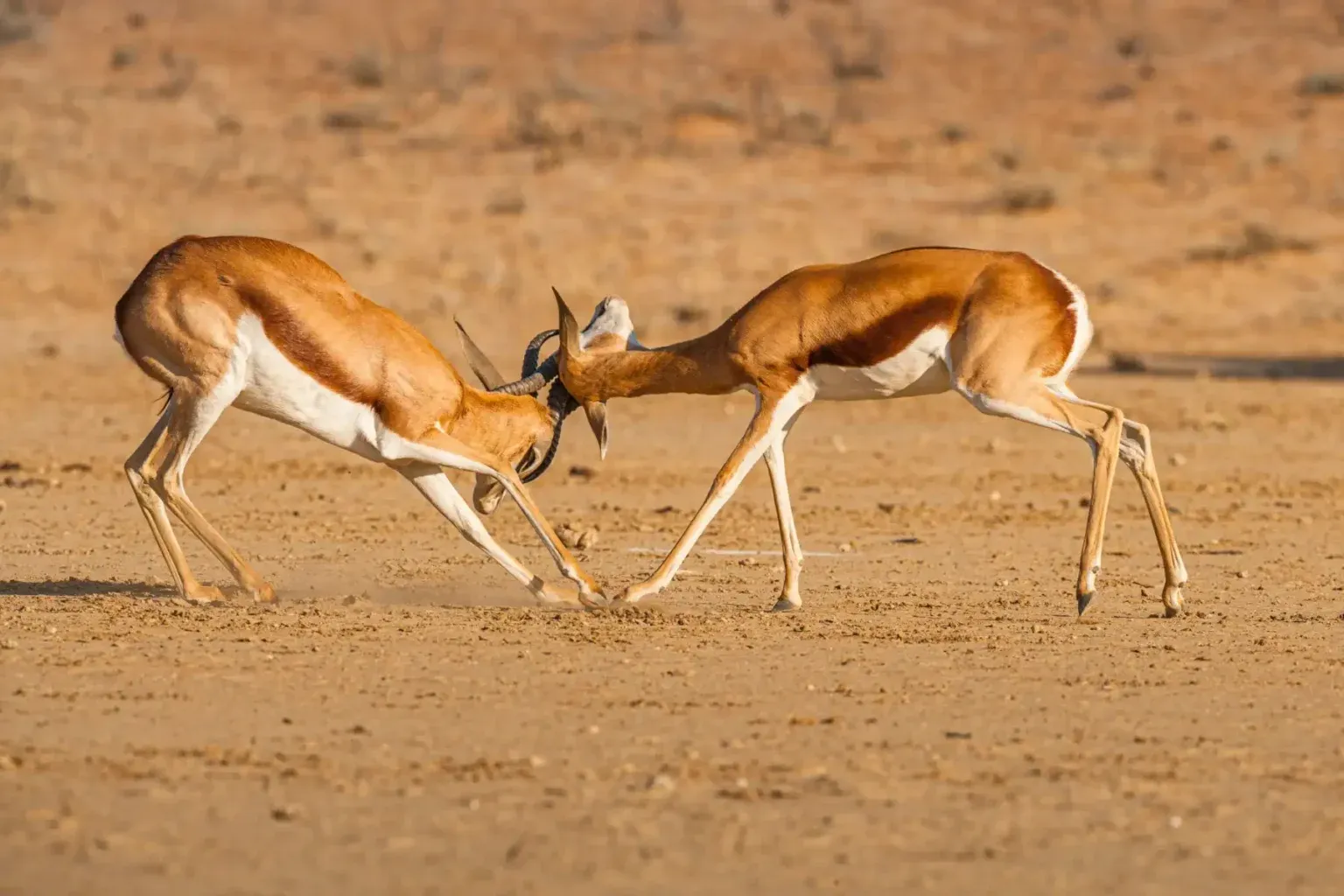
The Kalahari is Botswana’s other face: a fossil desert of golden grass and endless sky, home to black-maned lions, cheetah on the open pans and some of the most charismatic small wildlife in Africa — habituated meerkats among them.
To the northeast lie the Makgadikgadi Pans, the salt-crusted bed of an ancient superlake. In the dry season you ride quad bikes across a surface that curves with the earth; after good rains the pans flood, drawing flamingos and Botswana’s zebra migration. Time with San bushman guides adds a human depth no game drive can.
Highlights of Kalahari & Makgadikgadi
Black-maned lions
The Kalahari’s famous desert-adapted prides, ranging huge territories.
Meerkats at dawn
Habituated colonies that warm up on — and sometimes climb — their visitors.
The salt pans
Quad biking and sleep-outs on the bed of an ancient superlake.
San bushman culture
Walk with Zu/’hoasi guides and read the desert the way its first people do.
Best time to visit the Kalahari
Dry season — crisp nights, quad biking on the pans and classic desert light.
Green season — the zebra migration, flamingos after rain and dramatic skies.
In the green months rates ease at many of these camps, the plains empty of vehicles and the light turns dramatic. What each season gives, and what it trades, is set out in our Safari Planning Guide.
Planning & cost
Usually two to three nights within a Botswana safari Every journey fully tailor-made.
Every journey is privately designed, with private guides and vehicles arranged where specified, the finest lodges, and a specialist on call throughout. At fly-in camps, game drives may be shared unless a private vehicle is reserved.
Practical details,
in one place
Money, health, connectivity and packing work the same way on every safari we plan, so they live in one place rather than on every page.
Continue exploring
Botswana
A Botswana safari is Africa’s water wilderness — the Okavango Delta, Chobe and the Kalahari.
Explore → ExperienceOkavango Delta
An Okavango Delta safari explores Africa’s great water wilderness by mokoro and 4x4.
Explore → BotswanaChobe National Park
Chobe — one of the greatest elephant gatherings on earth, seen from the water.
Explore → RegionSouthern Africa
The desert, the delta and the falls — Botswana, Namibia, Zambia, Zimbabwe and South Africa.
Explore →Kalahari & Makgadikgadi FAQs
Getting to Botswana — flights, visas and health
Current at the time of writing. We re-confirm every requirement for your exact routing before you travel — and we will tell you what to apply for, and when.
Let's design your Kalahari & Makgadikgadi journey.
A Kalahari safari is quieter than most, and that is precisely its appeal.
Tell us how you like to travel and start with a complimentary consultation. When you are ready, a $500 USD planning fee covers your personalized itinerary and revisions, and is deducted from your booking deposit when you book.
Inquire now