
Lion characteristics start with sheer size. The lion (Panthera leo) is Africa’s largest cat. Males weigh 330–550lbs (150–250kg) and stand about four feet at the shoulder. The mane is unique among cats, and its size and color show a male’s age, health and strength. Lions are also the only cats that live socially, in prides of related lionesses, their cubs and a coalition of males. Lions are one of the five animals of a Big Five safari.
Lionesses do about 90% of the hunting. They ambush wildebeest, zebra and buffalo together, usually at night. Meanwhile, the males patrol and defend the territory, and a single roar carries five miles (8km). Because lions are built for power rather than stamina, they sprint at up to 50mph (80km/h) in short bursts and rest up to 20 hours a day. On safari, you see all of this in one sighting: a tawny coat in golden grass at dawn, then the roar after dark.
The 10 key characteristics of a lion
- Africa’s largest cat — males weigh 330–550 lb (150–250 kg), stand about 4 ft (1.2 m) at the shoulder and measure up to 10 ft from nose to tail.
- The mane — unique among cats; its size and color signal a male’s age, health and strength.
- The only social cat — prides hold related lionesses, their cubs and a coalition of males, from a handful to more than 30 animals.
- Lionesses do the hunting — about 90% of it, in coordinated ambushes on wildebeest, zebra and buffalo, usually at night.
- Built for power, not stamina — a lion sprints at up to 50 mph (80 km/h), but only in short bursts.
- The loudest roar of any big cat — around 114 decibels, carrying about five miles (8 km).
- Big eaters — a male can eat over 70 lb (30 kg) of meat in one sitting.
- Rest most of the day — lions sleep or rest for up to 20 hours out of 24.
- Lifespan — around 10–14 years in the wild; 20 or more in captivity.
- Vulnerable — around 20,000–25,000 remain in the wild, down roughly 40% in three decades.
Lion quick facts
| Scientific name | Panthera leo |
|---|---|
| Male weight | 330–550 lb (150–250 kg) |
| Female weight | 270–400 lb (120–180 kg) |
| Shoulder height | About 4 ft (1.2 m) |
| Length, nose to tail | Up to 10 ft (3 m) |
| Top speed | 50 mph (80 km/h), short bursts |
| Roar | About 114 dB, heard 5 miles (8 km) away |
| Pride size | A handful to 30+ animals |
| Lifespan | 10–14 years wild; 20+ in captivity |
| IUCN status | Vulnerable; about 20,000–25,000 left |
| Best places to see them | Serengeti (about 3,000 lions), Maasai Mara, Okavango |
Reviewed by Evance — Safari Specialist · Updated 5 October 2026
Lion characteristics, up close
Size & strength
Males weigh 330–550lbs and stretch up to 10ft nose to tail. That makes the lion Africa’s largest cat, with a bite about three times stronger than a human’s.
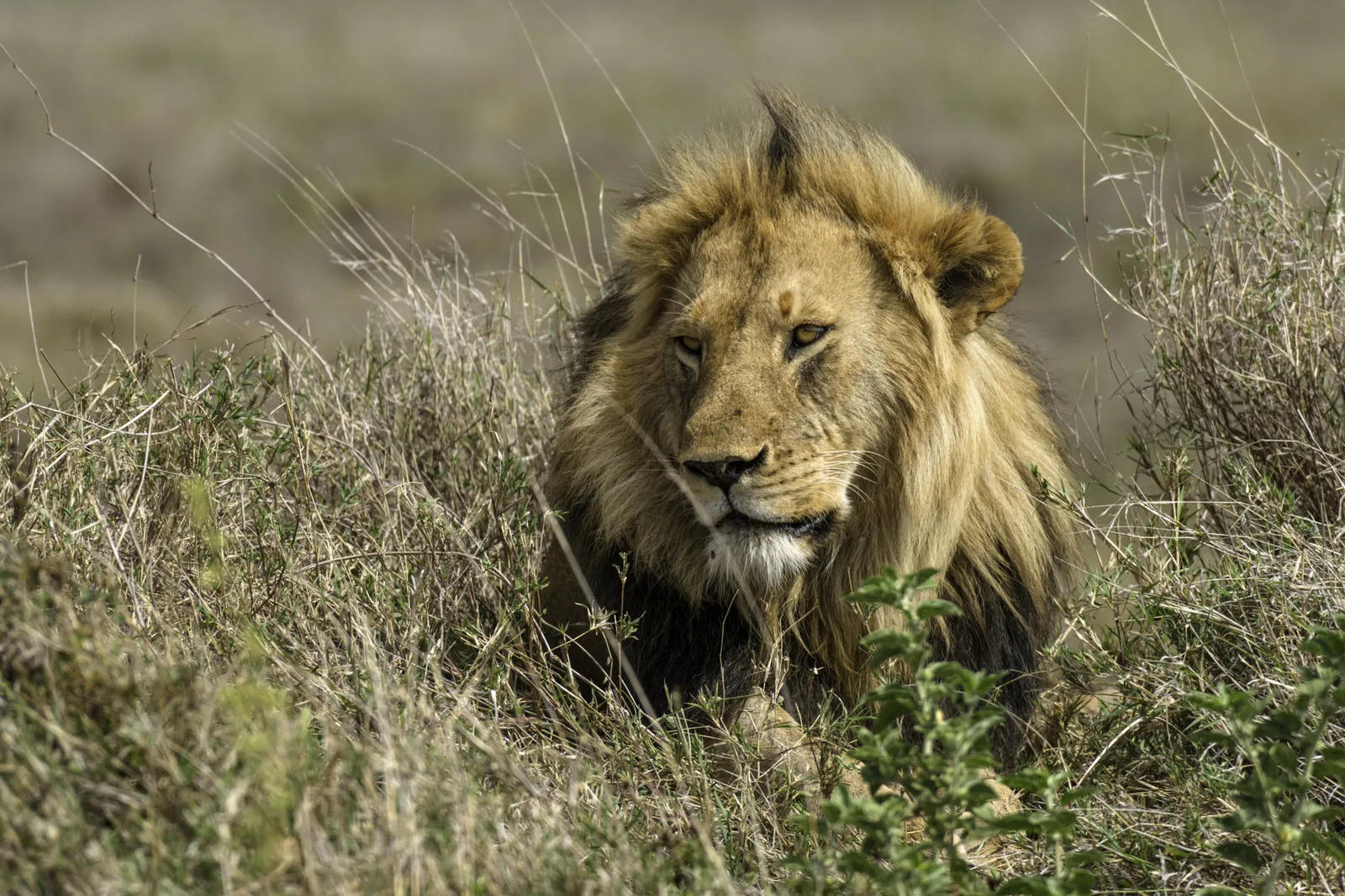
The mane
No other cat has one. Manes run from blond to black and darken with age. A full, dark mane shields the neck in fights and tells lionesses a male is in his prime.
Pride life
Lions are the only social cats. A pride holds related lionesses, their cubs and a coalition of males — anywhere from a handful to more than 30 animals.
Hunting & diet
Lionesses hunt as a team, mostly at night, and strike from ambush. Wildebeest, zebra, buffalo and antelope make up most of the menu.
Speed & the roar
A lion sprints at up to 50mph in short bursts. Its roar is the loudest of any big cat and carries five miles — a territorial broadcast at dawn and dusk.
Where to see them
The Serengeti and Maasai Mara hold Africa’s densest lion populations. In the Okavango, prides even hunt in water.
Explore Where to see them →Best time to see lions
Dry season — prey gathers at water, so lions are easiest to find.
Calving season on the southern Serengeti brings dramatic predator action.
In the green months rates ease at many of these camps, the plains empty of vehicles and the light turns dramatic. What each season gives, and what it trades, is set out in our Safari Planning Guide.
Planning & cost
Fully tailor-made — priced privately to your camps, season and travel style. No fixed packages.
Every journey is privately designed, with private guides and vehicles arranged where specified, the finest lodges, and a specialist on call throughout. At fly-in camps, game drives may be shared unless a private vehicle is reserved.
Everything else,
answered before you ask
The practical details that apply to every safari we plan — so this page is the only one you need.
US dollars and cards cover nearly everything, and tips are the only real cash need — exact amounts and etiquette are in our Safari Planning Guide.
See a travel clinic 6–8 weeks before departure for routine shots and malaria advice (most safari regions require prophylaxis; parts of South Africa are malaria-free). Camps are remote but professionally run, with radio contact and evacuation cover — we require travel insurance that includes emergency medical evacuation.
Connected in camp, gloriously offline on the drives — the full connectivity picture is in our Safari Planning Guide.
Soft duffel bags only (light aircraft cap luggage around 33 lb / 15 kg), neutral-colored layers for cold mornings and warm afternoons, and binoculars. Laundry is included at almost every camp, so pack for 4–5 days no matter the trip length.
Full packing list →Continue exploring
Big Five Safari
A Big Five safari — lion, leopard, elephant, buffalo and rhino, Africa’s most sought-after sightings.
Explore → TanzaniaSerengeti National Park
The Serengeti — endless plains, two million wildebeest and some of Africa’s finest big-cat country.
Explore → KenyaMaasai Mara
The Maasai Mara — big cats, river crossings and some of the finest year-round game viewing in Africa.
Explore →The African Lion FAQs
Let's design your African Lion journey.
Understanding lion characteristics changes what you notice on a game drive.
Tell us how you like to travel and start with a complimentary consultation. When you are ready, a $500 USD planning fee covers your personalized itinerary and revisions, and is deducted from your booking deposit when you book.
Inquire now