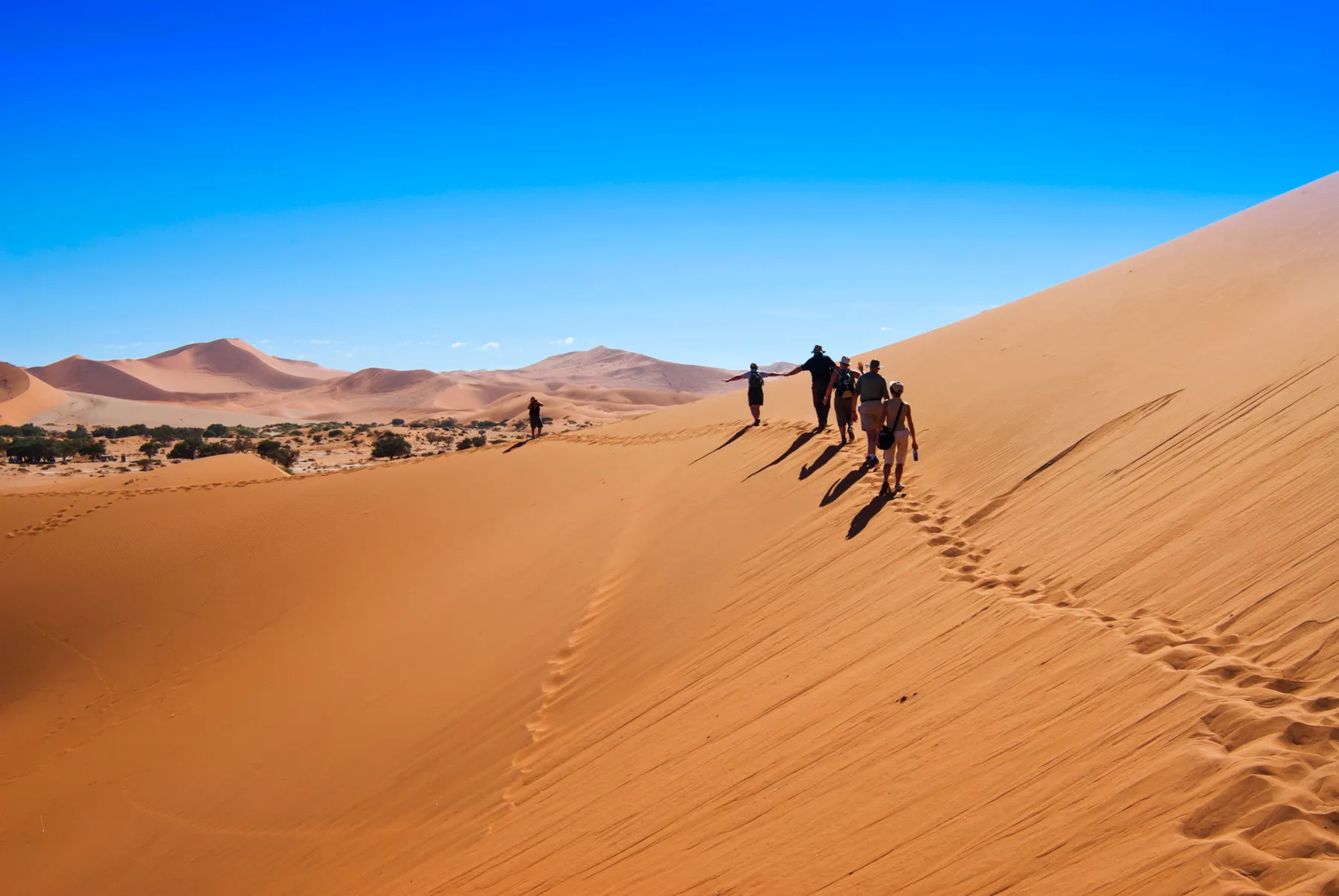
Sossusvlei is the Namib Desert’s great amphitheater — apricot dunes rising 300 meters above white clay pans, at their most vivid in the first hour after dawn. Deadvlei, its famous neighbor, holds 900-year-old camelthorn skeletons black against the clay: one of the most photographed scenes on the planet.
The surrounding NamibRand and private desert reserves offer some of the darkest certified night skies on earth, quad-bike and e-bike dune excursions, and hot-air ballooning over a sea of sand.
Highlights of Sossusvlei & the Namib
Deadvlei at dawn
Black trees, white clay, orange dune — be there before the light flattens.
Big Daddy & Dune 45
Climb a giant at sunrise and run down the slip-face.
Dark-sky stargazing
The NamibRand is an International Dark Sky Reserve — the Milky Way like you have never seen it.
Balloon over the Namib
Dawn flight over the dune sea with a champagne breakfast on landing.
Best time to visit Sossusvlei
Cooler, clearer months — crisp dawns and comfortable dune climbs.
Hot summer — dramatic storm light and the desert occasionally in rare bloom.
In the green months rates ease at many of these camps, the plains empty of vehicles and the light turns dramatic. What each season gives, and what it trades, is set out in our Safari Planning Guide.
Planning & cost
Fully tailor-made — priced privately to your camps, season and travel style. No fixed packages.
Every journey is privately designed, with private guides and vehicles arranged where specified, the finest lodges, and a specialist on call throughout. At fly-in camps, game drives may be shared unless a private vehicle is reserved.
How a day in the dunes works
The dunes lie inside Namib-Naukluft National Park, about 60 kilometers (37 miles) from the Sesriem gate on a paved road. The last few kilometers to Sossusvlei and Deadvlei are deep sand, covered in a 4x4 or the park shuttle. Guests staying inside the park gate can set off before sunrise, which is how you reach Deadvlei while the light is still low and the pan is quiet.
Plan any climb for the cool of early morning. Dune 45 is the easy, much-photographed climb close to the road; Big Daddy, above Deadvlei, is far taller and takes most people an hour or more in soft sand. Carry water and a hat, because the temperature climbs fast once the sun is up, and midday is best spent back in camp.
Most travelers give Sossusvlei two nights and reach it by light aircraft from Windhoek or as part of a fly-in circuit with Damaraland and Etosha; our fly-in safari guide explains how those flights work. Self-drive is popular too, on long gravel roads. The wider country is covered on our Namibia page.
Practical details,
in one place
Money, health, connectivity and packing work the same way on every safari we plan, so they live in one place rather than on every page.
Continue exploring
Namibia
A Namibia safari crosses the red dunes of Sossusvlei, Etosha’s waterholes and the Skeleton Coast.
Explore → NamibiaEtosha National Park
Etosha — a shimmering salt pan where the wildlife comes to you.
Explore → ExperienceHoneymoon & Romance
A honeymoon safari pairs private game viewing with barefoot beaches, planned as one journey.
Explore → RegionSouthern Africa
The desert, the delta and the falls — Botswana, Namibia, Zambia, Zimbabwe and South Africa.
Explore →Sossusvlei & the Namib FAQs
Getting to Namibia — flights, visas and health
Current at the time of writing. We re-confirm every requirement for your exact routing before you travel — and we will tell you what to apply for, and when.
Let's design your Sossusvlei & the Namib journey.
Sossusvlei is worth an early start and a second night, rather than a passing stop.
Tell us how you like to travel and start with a complimentary consultation. When you are ready, a $500 USD planning fee covers your personalized itinerary and revisions, and is deducted from your booking deposit when you book.
Inquire now