The single most common question we hear from American travelers is not about lions or lodges — it is “how do I actually get there?” If you have never flown intercontinentally, words like “connection” and “layover” can feel intimidating. They shouldn’t: reaching a safari from anywhere in the United States is a well-worn path, and this guide walks through it in plain English.
The short answer
Fly into the gateway for your safari region, usually with one connection: Nairobi for Kenya, Kilimanjaro for northern Tanzania, Kigali or Entebbe for the gorillas, and Johannesburg or Cape Town for Southern Africa. Nonstop flights exist on a few routes and change by season, so treat the patterns below as routing shapes rather than timetables; we check live schedules against your dates before anything is booked.
| Safari region | Gateway airport | How US travelers usually route |
|---|---|---|
| Kenya | Nairobi (NBO) | One stop via Europe or the Gulf; a nonstop from New York when it is operating. |
| Northern Tanzania | Kilimanjaro (JRO) | One stop via Amsterdam, Doha, Addis Ababa or Nairobi. |
| Rwanda and Uganda | Kigali (KGL) or Entebbe (EBB) | One stop via Brussels, Amsterdam, Doha or Nairobi. |
| South Africa, Botswana, Zambia, Zimbabwe | Johannesburg (JNB) or Cape Town (CPT) | Nonstops from Atlanta and New York, or one stop via Europe or the Gulf, then a short regional flight. |
| Indian Ocean islands | Zanzibar (ZNZ), Seychelles (SEZ), Mauritius (MRU) | A regional flight from your safari gateway rather than a separate long-haul. |
Country pages: Kenya, Tanzania, gorilla trekking, South Africa and beaches and islands.
First, the basics: what a connection actually is
Very few flights go from the US straight to a safari country, so most journeys have one “connection”: you fly to a hub city, walk to another gate, and board a second plane — usually on one ticket, with your bags checked through to the end. The “layover” is simply the wait between the two flights; two to four hours is comfortable. Because everything is on one ticket, if the first flight runs late the airline rebooks you at no cost — which is exactly why we advise against booking two separate tickets to save money.
The nonstop flights that exist today
A handful of true nonstops link the US to Africa, all from East Coast hubs. If you live elsewhere in the US, you simply take a domestic flight to one of these cities first — on the same ticket.
- —New York JFK → Nairobi, Kenya — Kenya Airways, about 14 hours. The only nonstop from the US to East Africa.
- —Atlanta → Johannesburg, South Africa — Delta, daily, about 15 hours.
- —Newark → Johannesburg, South Africa — United, daily, about 15 hours.
- —Newark & Washington Dulles → Cape Town, South Africa — United, about 15 hours.
- —Atlanta → Cape Town, South Africa — Delta, seasonal in the northern winter, about 16 hours.
- —Washington Dulles, Newark, New York JFK, Chicago & Atlanta → Addis Ababa — Ethiopian Airlines, connecting onward across Africa. Some of these routings make a brief stop en route rather than flying straight through.
Airlines add and cut long-haul routes season by season, so treat this as the shape of the map rather than a timetable. We confirm what is actually flying on your dates when we plan your journey.
No nonstop to your safari country? Here is how it works
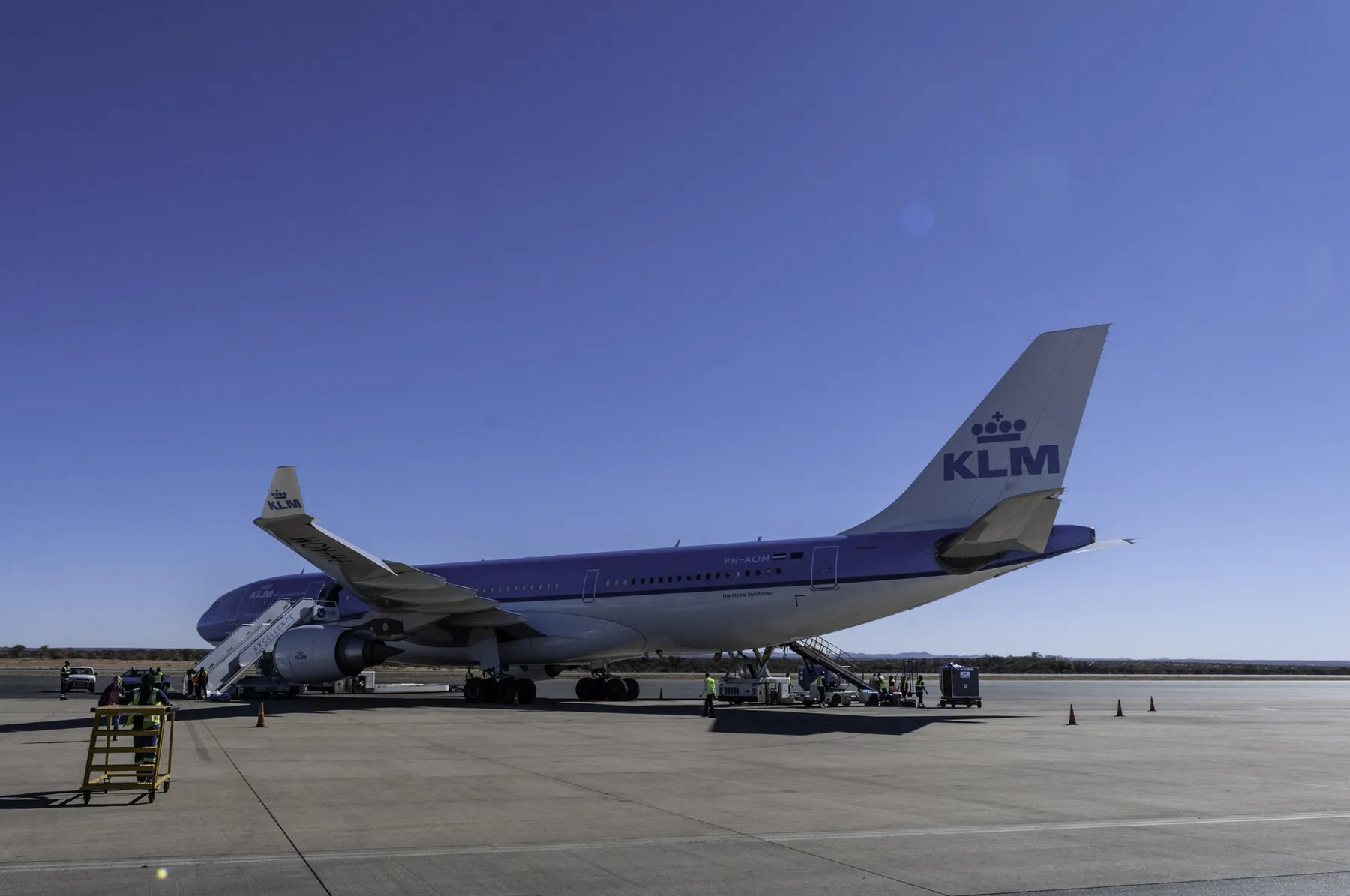
Tanzania, Botswana, Rwanda, Zambia and Zimbabwe have no nonstop flights from the US — everyone connects once, and the well-trodden routes are excellent. For Tanzania, the classic routings are KLM through Amsterdam or Qatar Airways through Doha, both landing at Kilimanjaro Airport; Delta flyers reach it via Amsterdam with KLM as their partner. For Botswana, Zambia and Zimbabwe you connect through Johannesburg, then hop north on a short regional flight. For Rwanda, Qatar Airways through Doha reaches Kigali directly.
- —Tanzania (Kilimanjaro) — via Amsterdam (KLM), Doha (Qatar) or Addis Ababa (Ethiopian)
- —Kenya (Nairobi) — nonstop from JFK, or via the same European/Gulf hubs
- —Botswana, Zambia, Zimbabwe — via Johannesburg, then a 1–2 hour regional flight
- —Rwanda (Kigali) — via Doha, Amsterdam (Brussels Airlines/KLM partners) or Addis Ababa
Eastern Africa: your gateway airports
Eastern Africa is the classic first safari — the Serengeti, the Maasai Mara, the gorillas of Rwanda and Uganda. Four gateways cover almost every itinerary we plan, and each has a different onward rhythm once you land.
- —Nairobi (NBO), Kenya — the only East African capital with a nonstop from the US. Light aircraft to the Maasai Mara and the northern conservancies leave from Wilson Airport, a 30–45 minute drive across the city, so we build in that transfer time rather than leaving it to chance.
- —Kilimanjaro (JRO), Tanzania — the closest airport to Arusha and the northern circuit, and the one we route almost every Tanzania guest through. A 45-minute private transfer reaches the garden lodges of Arusha; bush flights to the Serengeti leave from Arusha Airport the next morning.
- —Kigali (KGL), Rwanda — small, calm and famously efficient. Gorilla trekking begins with a two to three hour drive north to Volcanoes National Park, which is why many guests fly in the evening and trek the day after next.
- —Entebbe (EBB), Uganda — the gateway for Bwindi and the chimpanzees of Kibale, usually reached via Doha, Addis Ababa, Amsterdam or a short hop from Kigali or Nairobi.
- —Zanzibar (ZNZ) & Dar es Salaam (DAR) — where a Tanzanian safari usually ends. Zanzibar connects directly from Kilimanjaro and the Serengeti airstrips, so the bush-to-beach transition needs no backtracking.
The practical upshot: from the East Coast you can be in Nairobi in one flight, and in the Mara by lunchtime the next day. Tanzania takes one connection through Amsterdam, Doha, Istanbul or Addis Ababa, and lands you a short drive from bed.
Southern Africa: Johannesburg, Cape Town and the safari hop
Southern Africa works differently. Rather than flying to a country and driving, you almost always route through one of South Africa’s two great airports and then take a short regional flight to the bush. Understanding those two airports removes most of the anxiety from the journey.
Johannesburg (JNB) — the connecting heart of the region
O.R. Tambo International is Southern Africa’s hub, and nearly every safari in Botswana, Zimbabwe, Zambia, Namibia and the Kruger region connects through it. Delta flies nonstop from Atlanta and United from Newark; from anywhere else in the US you connect once, in Atlanta, Newark or a European or Gulf hub.
- —Onward flights from Johannesburg reach the Kruger’s private reserves (Skukuza, Hoedspruit and Nelspruit) in about an hour, Maun and Kasane in Botswana in under two, Victoria Falls in about ninety minutes, and Windhoek in two.
- —If your bush flight is a separate booking from your international ticket, you must clear immigration, collect your bags and re-check them — allow at least three hours. On a single through-ticket, two is usually enough.
- —Many guests spend the first night at a hotel minutes from the terminal rather than pushing straight on. It costs one evening and buys a rested start.
- —The airport is well signed, English-speaking and straightforward; the walk between international arrivals and the domestic terminal is indoors and takes about ten minutes.
Cape Town (CPT) — the city worth its own days
Cape Town has its own nonstops — United from Newark and Washington, Delta from Atlanta in the peak season — which means you can begin or end a trip there without passing through Johannesburg at all. It is a two-hour flight from Johannesburg if you would rather do the safari first.
- —Our usual shape: safari first while your energy is high, then Cape Town and the winelands to unwind before the flight home. Table Mountain, Franschhoek and the Cape peninsula deserve three or four nights, not one.
- —Cape Town’s season is the mirror of the bush: November to March is warm and dry there, which pairs neatly with Kruger’s green season and with Botswana’s water months.
- —The airport sits twenty minutes from the city — the shortest airport-to-hotel run of any gateway in this guide.
The rest of Southern Africa
- —Botswana — fly into Maun for the Okavango Delta or Kasane for the Chobe, both via Johannesburg. Camps are reached by light aircraft from there.
- —Zimbabwe & Zambia — Victoria Falls and Livingstone sit on opposite banks of the same waterfall, twenty minutes apart by road; either works, and the border crossing is routine.
- —Namibia — Windhoek via Johannesburg, then light aircraft or a self-drive that many guests consider the trip itself.
- —Mozambique — the island lodges connect through Johannesburg to Vilanculos or Inhambane, and pair beautifully with a Kruger safari.

Islands, North Africa and the longer journeys
Not every journey ends in the bush. These are the routings we book most often for the days on either side of a safari.
- —Seychelles (SEZ) — via Doha, Dubai, Addis Ababa or Nairobi; the natural finish to a Kenyan safari.
- —Mauritius (MRU) — via Dubai, Doha, Paris or Johannesburg, and an easy pairing with South Africa.
- —Egypt (CAI) — nonstop from New York, or via any European hub; Nile cruises begin with a short domestic flight to Luxor or Aswan.
- —Morocco (CMN, RAK) — the shortest long-haul in this guide, with nonstops from New York and Washington to Casablanca and easy European connections to Marrakech.
Two details that catch people out
Both are easy to handle when you know about them months ahead, and genuinely disruptive when you discover them at check-in. We confirm each one for every guest before travel.
- —Yellow fever certificates. Kenya, Tanzania and South Africa require proof of vaccination from travelers arriving from a yellow-fever risk country — and a long layover in one, such as Nairobi or Addis Ababa, can count. This surprises people combining East and Southern Africa, so we check your exact routing rather than only your destinations.
- —Light-aircraft baggage. The bush flights that reach the camps limit you to a soft-sided bag, typically around 15kg (33lb) including hand luggage. Hard suitcases will not fit through the hold door. Every camp launders daily, so far less clothing is needed than instinct suggests — and gateway hotels will store anything you would rather not carry.
When to book, and what we handle
Long-haul fares to Africa move with the seasons rather than with the day of the week. For travel in the peak months of June to October, we recommend holding your flights nine to eleven months out; for the green season the window is more forgiving. Award seats on Delta, United and their partners open around eleven months ahead and disappear quickly.
You book the international flights yourself, or with your miles — but not before we have advised on the routing, because the right arrival time can save an entire day of your safari. Everything after you land is ours: the private transfers, the gateway hotels, the light aircraft between camps, and someone reachable at any hour if a schedule shifts.
How long will the whole journey take?
From the East Coast, plan on 15–20 hours door to door with one connection. From the Midwest, Texas or the West Coast, add the domestic leg or a longer connection — typically 20–26 hours in total. It sounds daunting; in practice it is one overnight flight (most travelers sleep through it), a coffee in a nice airport, and one more leg. You lose a day going and gain most of it back coming home.
Visas — what each country requires of US citizens
Every safari country handles US visitors differently, and this is where new travelers most often get caught out. The rules below are current as of mid-2026 — we re-confirm them for every client at booking, because they do change.
- —Tanzania — $100 multiple-entry e-visa, applied for online before travel
- —Kenya — electronic travel authorization (eTA), about $30, applied for online
- —South Africa — no visa for stays up to 90 days; complete the online traveler declaration before arrival
- —Rwanda — visa on arrival ($50) or online in advance; East Africa Tourist Visa ($100) covers Rwanda, Kenya and Uganda together
- —Botswana, Zambia & Zimbabwe — Botswana and Zambia are visa-free for US passports; Zimbabwe issues a visa on arrival (the $50 KAZA UniVisa covers eligible Zambia–Zimbabwe Falls combinations)
- —All countries — passport valid 6+ months beyond travel, with 2–4 blank pages
Where to apply: the official links
Apply only through the official government portals below. Search results are crowded with look-alike agency sites that charge a fee on top of the real one and are not affiliated with any government. Nothing here needs an intermediary — every application is one you can complete yourself in fifteen minutes, and we will check your confirmations before you fly.
- —Tanzania — e-visa: visa.immigration.go.tz. Apply two to four weeks ahead; approval usually arrives within ten days.
- —Kenya — electronic travel authorization: etakenya.go.ke. Everyone needs one, including infants and passengers merely transiting overnight.
- —Uganda — e-visa: immigration.go.ug, which is also where the East Africa Tourist Visa is issued.
- —Rwanda — apply through irembo.gov.rw, or take the visa on arrival; gorilla permits are arranged separately, by us.
- —Zambia — eservices.zambiaimmigration.gov.zm.
- —Zimbabwe — evisa.gov.zw. For Victoria Falls guests crossing between the two countries, ask about the KAZA UniVisa instead.
- —South Africa, Botswana & Namibia — no tourist visa is required of US passport holders for short stays. Confirm the current entry rules and any arrival declaration on the country page at travel.state.gov before you fly.
One warning worth repeating: apply from the official domain only, and be suspicious of any site asking for payment by bank transfer or charging far more than the fees quoted above.
Health: yellow fever, malaria and the rules that follow your route
Health requirements in Africa follow your itinerary, not just your destination — which is why two travelers heading to the same lodge can face different paperwork. Your doctor or a travel clinic makes the final call; the sources below are the ones they will use.
Yellow fever — the certificate that surprises people
- —Kenya, Uganda and Rwanda require proof of yellow fever vaccination from travelers arriving from a country where the disease is present.
- —Tanzania and South Africa require it only if you are arriving from such a country — and a layover longer than twelve hours can count as arriving from there. A US traveler flying home from the Serengeti via Nairobi, or on to Cape Town via Addis Ababa, can be asked for the certificate at the desk.
- —The vaccination must be given at least ten days before arrival, and the certificate is valid for life. Find an authorized center and the current country list at the CDC vaccination clinic finder and the CDC country pages.
- —Carry the yellow booklet itself, not a photo of it, and keep it with your passport.
Malaria and routine vaccinations
- —Most safari areas are malarial, and prophylaxis is prescribed as a matter of course; the tablets are simple and the camps supply nets and repellent. A handful of regions — parts of the Cape, the Kalahari and Namibia’s desert — are malaria-free, and we will tell you plainly which of your camps are.
- —Your clinic will also check routine cover such as tetanus, hepatitis A and typhoid.
- —Country-by-country guidance for US travelers: CDC Travelers’ Health destination pages.
Two things every US traveler should do before departure
- —Check your passport: most of these countries require six months’ validity beyond your return date and two to four blank pages. Renewals at travel.state.gov/passports.
- —Enroll in STEP, the Smart Traveler Enrollment Program — free, takes two minutes, and lets the nearest US embassy reach you if anything changes while you are away.
- —Travel insurance with medical evacuation cover is not optional on safari; remote camps rely on air evacuation, and we will not send you without it.
Fees, portals and requirements do change. Everything above was correct when this guide was last updated, and we re-confirm every detail against the official sources for your exact routing before you travel — but the links are here so you can see the rules for yourself, first-hand.
Arriving rested — and the last leg to camp
East and Southern Africa sit only 6–9 hours ahead of US time zones, so jet lag is real but shorter-lived than a trip to Asia. We usually build in a night at a comfortable gateway hotel on arrival, so you start your safari refreshed rather than stepping off a red-eye onto a game drive. From the gateway city, a light aircraft flies you the final stretch to camp — a spectacular low-level flight over the plains that is part of the experience, and always arranged and included by us. Your international flights you book yourself or with your miles; we advise on the best routing for your city, dates and budget before you do.
Getting to safari from your US city
Every routing below is a shape, not a timetable: airlines add and cut long-haul flights by season, and we check live schedules against your dates before anything is booked. Journey times are gate to gate including one connection.
| Flying from | How US travelers usually route to safari | Typical journey time |
|---|---|---|
| New York (JFK / Newark) | Nonstop to Nairobi (Kenya Airways) and Johannesburg or Cape Town (United); one stop via Amsterdam, Doha or Addis Ababa to Kilimanjaro, Kigali or Entebbe | 14–15 h nonstop; 17–20 h with one stop |
| Washington DC (Dulles) | Nonstop to Cape Town (United) and Addis Ababa (Ethiopian) for connections across East Africa; one stop via Europe or the Gulf elsewhere | 15–16 h nonstop; 18–21 h with one stop |
| Atlanta | Nonstop to Johannesburg year-round and Cape Town in the northern winter (Delta); KLM via Amsterdam to Kilimanjaro and Nairobi | 15–16 h nonstop; 18–21 h with one stop |
| Boston, Philadelphia, Miami | Domestic hop to New York, Washington or Atlanta on the same ticket, or one stop via Amsterdam, Paris, London or Doha | 18–22 h door to door |
| Chicago, Dallas, Houston | Ethiopian from Chicago to Addis Ababa; otherwise one stop via Doha, Istanbul, Frankfurt or Amsterdam | 19–23 h door to door |
| Los Angeles, San Francisco, Seattle | One stop via Doha, Dubai, Istanbul, Amsterdam or Paris to any gateway; the Gulf hubs usually give the smoothest single connection | 22–26 h door to end |
Time zones and jet lag
East Africa (Kenya, Tanzania, Uganda) is 7 hours ahead of New York and 10 ahead of Los Angeles; Rwanda and Southern Africa (South Africa, Botswana, Zambia, Zimbabwe) are 6 and 9 hours ahead respectively, with no daylight-saving changes on the African side. Flights from the East Coast land in the evening or early morning, which is why we build a first night near the gateway airport before the light-aircraft hop to camp: you arrive in the bush rested and on time for the first game drive.
Why plan an African safari with a US-registered company
NndeeAfrika LLC is registered in California as a Seller of Travel (CST 2173450-50), so you contract in US dollars under US consumer-protection rules, with planning and support in your own time zone and Tanzanian-born knowledge on the ground. Every East African safari we plan includes AMREF Flying Doctors emergency evacuation cover, and we handle the whole journey door to door: international flights, the light-aircraft legs, visas and the mandatory Tanzania inbound insurance. How we look after you · How to plan an African safari Planning African safari tours for seniors from the USA? Our senior safari guide covers the pace and the easiest routes.
Questions US travelers ask
Are there nonstop flights from the US to an African safari?
A few, all from East Coast hubs: New York JFK to Nairobi (Kenya Airways), Atlanta and Newark to Johannesburg (Delta, United), Newark and Washington Dulles to Cape Town (United), and Atlanta to Cape Town in the northern winter (Delta). Everywhere else connects once, typically via Amsterdam, Doha, Addis Ababa or Istanbul.
How long is the flight from the US to Tanzania or Kenya?
About 14 hours nonstop from New York to Nairobi. To Kilimanjaro for Tanzania there is no nonstop: expect 17 to 20 hours gate to gate from the East Coast with one connection, and 22 to 26 hours from the West Coast.
What is the time difference between the US and East Africa?
Kenya, Tanzania and Uganda are 7 hours ahead of New York and 10 hours ahead of Los Angeles; Rwanda and Southern Africa are one hour less. Africa does not change clocks for daylight saving, so the gap shifts by an hour twice a year.
Do US citizens need a visa for a safari?
It depends on the country: Kenya requires an electronic travel authorisation, Tanzania a $100 multiple-entry eVisa applied for online, while South Africa and Botswana are visa-free for US passport holders. Rules change, so we send a checklist with the exact steps once your route is set.