
Evance grew up in the shadow of Kilimanjaro, so for us these aren't “tribes” in a guidebook — they're neighbors, in-laws, the guides we've worked beside for years. That's the spirit we try to pass on to you.
Northern Tanzania is one of the few places on earth where three completely different ways of living sit within a morning's drive of one another. The Maasai measure their world in cattle. The Hadzabe still live by the hunt, much as people did long before farming existed. The Datoga work iron over open fires the way their grandparents did. None of them are relics — they're living communities, changing on their own terms.
A cultural day on safari can be one of the most memorable parts of a trip — or it can feel like a staged stop for photographs. The difference is entirely in how it's arranged. We visit by invitation, keep groups small, and let people show you what they actually want to share.
Below is a plain, honest introduction to each of the three peoples you're most likely to meet — where they live, how they spend their days, and what a visit is really like.
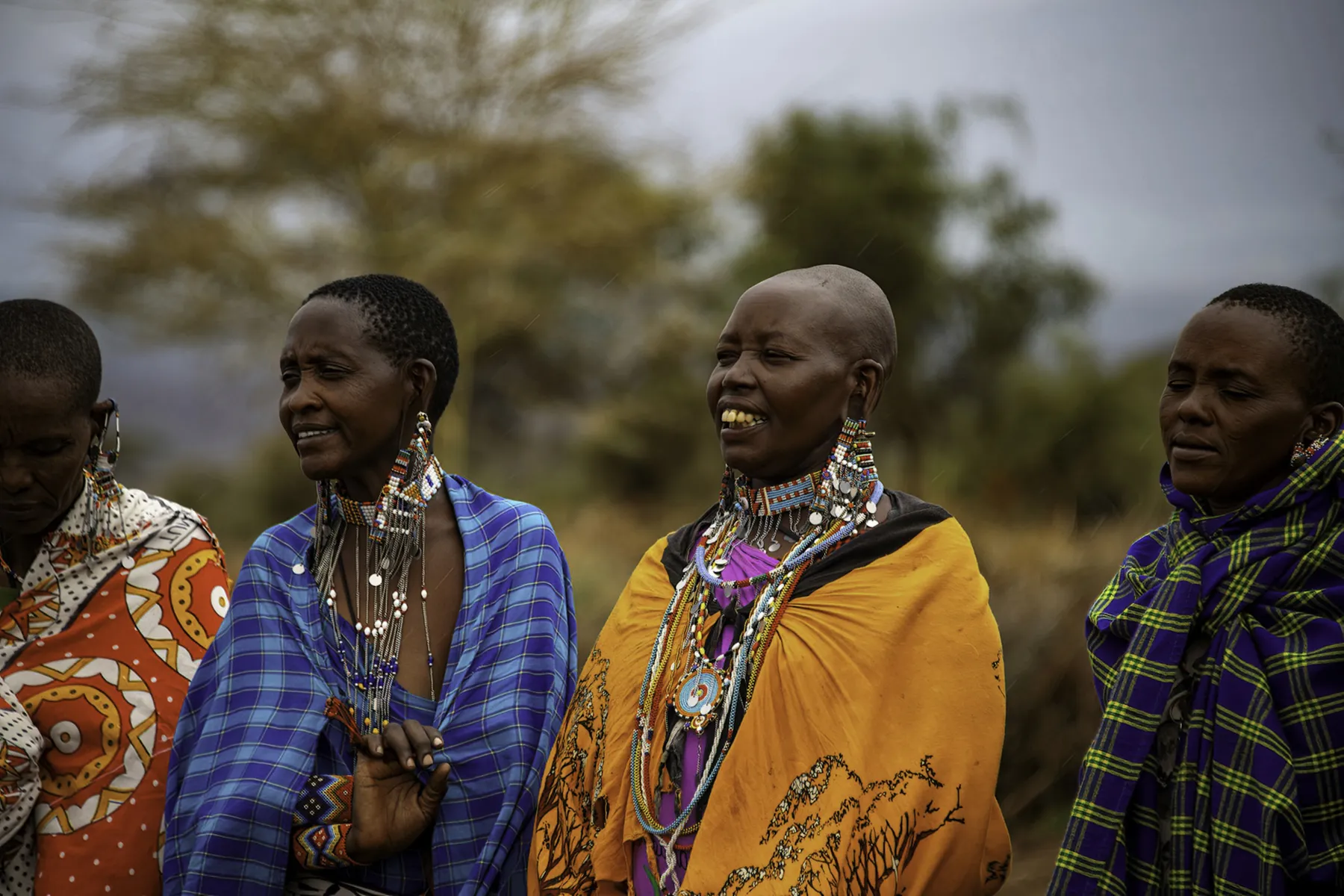
The Maasai
A safari isn't only about the animals. Around Tanzania's Serengeti and Ngorongoro highlands live communities who have called this country home far longer than any park boundary — the Maasai, the Hadzabe and the Datoga. This is who they are, and how to meet them well.
The Maasai are probably the face you already picture when you think of East Africa — tall figures in red cloth against a yellow plain. They're semi-nomadic herders who move across southern Kenya and northern Tanzania, and they've famously held onto their way of life while the modern world rearranged everything around them.
Cattle are the center of everything — wealth, food, status, ceremony. A family's herd is its bank account and its history. You'll see homesteads called bomas: a ring of low houses the women build from mud, sticks and dung, wrapped in a thorn fence to keep the livestock safe at night. Young men once passed through the age-set system to become morani, the warriors who guarded the herds — a rite of passage still marked with real ceremony today.
A visit usually means being welcomed into a boma, shown how a house is built and a fire is made, and — if the mood is right — pulled into the adumu, the jumping dance where the men leap straight-backed into the air. What stays with most people isn't the beadwork or the dancing, though. It's how quickly the formality drops and it just becomes a conversation.
The Hadzabe
On the scrubby shores of Lake Eyasi live the Hadzabe — one of the last true hunter-gatherer peoples anywhere on earth. There are only around a thousand of them, and a few hundred still live almost entirely off the land, without farming, livestock or permanent houses. Spend a morning with them and you're watching a way of life older than agriculture itself.
The men hunt at first light with handmade bows and poison-tipped arrows; the women and children gather tubers, berries and, when they're lucky, wild honey led to the hive by a bird they whistle to. Nothing is stored and little is owned. Their language is like no other — a rapid speech full of clicks that linguists have never been able to tie to any neighboring tongue.
Visits happen at dawn, because that's when the hunt happens. You walk out with the men as the light comes up — fast, quiet, completely unstaged — and later sit by the fire as the day's food is shared out. It is humbling in a way that's hard to describe until you've done it.
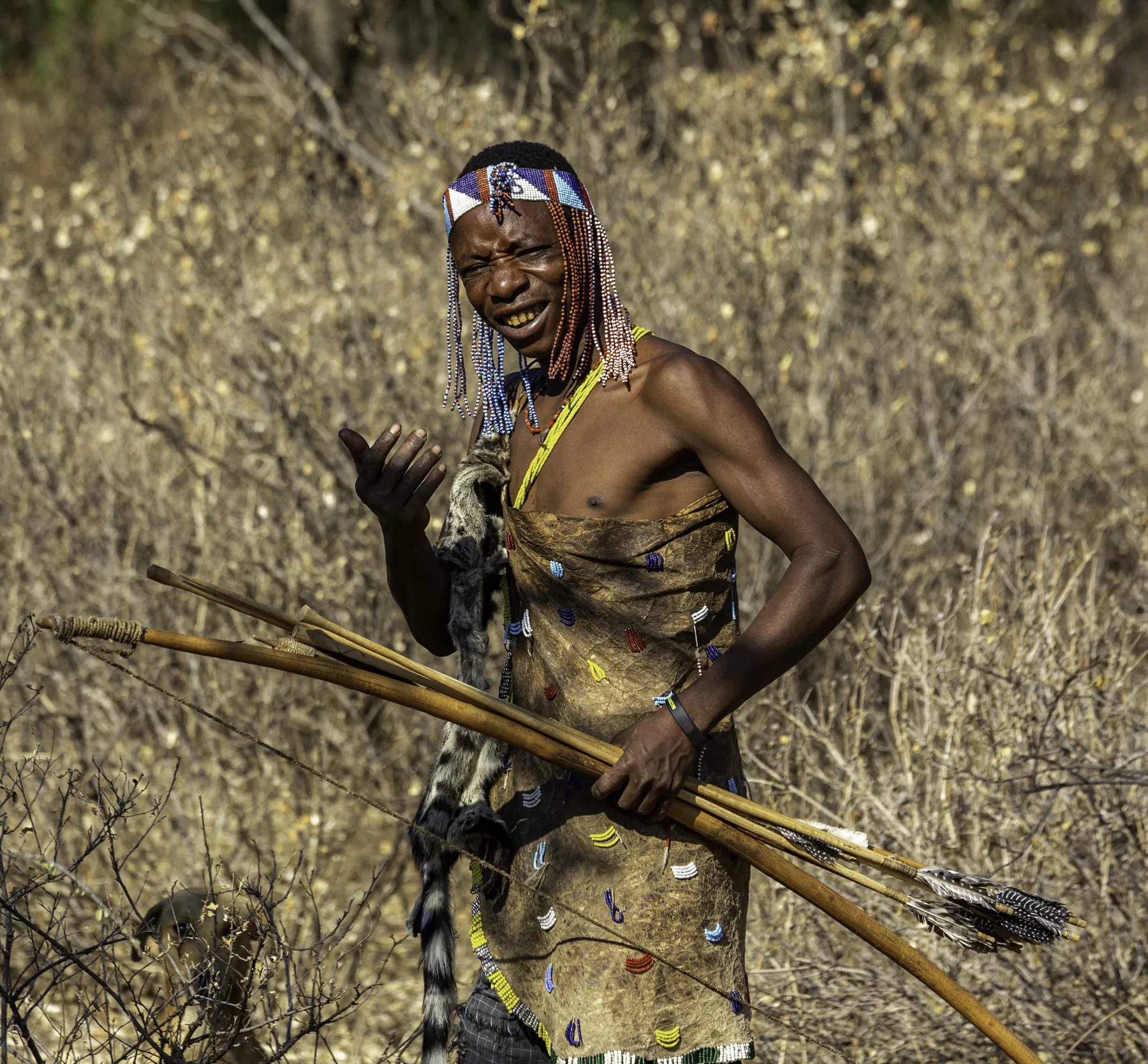

The Datoga
Sharing the Lake Eyasi country with the Hadzabe are the Datoga — proud, semi-nomadic cattle herders with a quieter fame: they are the region's blacksmiths. Working at open fires with goatskin bellows and simple stone tools, they forge arrowheads, spear tips, knives and the coiled brass jewelry their women are known for. The very arrows the Hadzabe hunt with are often traded from a Datoga forge nearby.
You'll recognize Datoga women by their beaded leather dresses, the brass bracelets stacked at the wrist, and the fine circular markings some wear around the eyes. Like the Maasai they live for their herds, but they keep more to themselves, tucked into the acacia country south of the Serengeti.
A visit often means standing at the forge while a smith turns a scrap of metal into an arrowhead in minutes — then seeing the beadwork and leatherwork the women make. It pairs naturally with a Hadzabe morning, since the two communities live side by side and have traded for generations.
A good cultural visit feels like being invited in — not buying a ticket to a show.
There's a version of cultural tourism that does real harm — big buses, staged dances, photos taken without asking, and almost none of the money reaching the family that hosted you. We've spent years building relationships that work the other way around. It's simple, and it isn't negotiable for us.
We visit by invitation
Only communities that genuinely want to host, on days that suit them — never a fixed stop forced into the itinerary.
The money reaches them
Fees are agreed up front and paid to the community directly, so the people you meet are the people who benefit.
Photos are always asked
We ask before we photograph, every time. Most people say yes warmly — but it's their choice to give, not ours to take.
Cultural safari questions
Add a day with the Maasai, Hadzabe or Datoga.
A Maasai culture safari is best added as a full day rather than a photo stop.
Tell us who you'd love to meet and we'll weave a cultural day into your Serengeti and Ngorongoro safari — arranged the right way, with the right people.
Start planning