Two weeks is the length most of our American guests settle on once they have done the flight arithmetic: long enough for two regions and a coast, short enough to fit a work calendar. It is also the length at which an itinerary stops being a checklist and becomes a journey. These are the five two-week shapes we plan most often, each built from itineraries you can read in full, with the rules for splitting the nights and what the whole thing costs.
Three rules for a two-week safari
Two regions, not four. Two nights in six places is a worse safari than four nights in three; an extra night in a park you are already in is worth more than an extra park. Keep every leg to one flight. The pairings that work are within a single light-aircraft hop or a short scheduled flight of each other. End somewhere still. After ten dawn starts, three or four nights on a coast or in a city is not an indulgence; it is how you fly home rested.
Five two-week routes we plan most
| Route | Length | The shape | Who it suits | Best months |
|---|---|---|---|---|
| The East Africa Circle | 13–14 days | Amboseli, a private Mara conservancy, the Serengeti and the Ngorongoro Crater in one arc | First safaris with one shot at Africa; the Migration in either country depending on month | June–October; January–February |
| Serengeti to the Spice Coast | 12–14 days | Tarangire, the Ngorongoro Crater and the Serengeti, then Zanzibar’s north coast | Honeymoons, families, anyone who wants bush and beach in one country | June–October; January–March |
| Cape, Falls & Delta | 12–14 days | Cape Town and the Winelands, Victoria Falls, the Okavango Delta by mokoro and boat | Travelers who want a city, a wonder of the world and the finest water safari | May–October |
| The Mara & the Indian Ocean | 12–14 days | Big cats in a private Mara conservancy, then the granite coves of the Seychelles | Honeymoons and milestone trips; the most restful finish in Africa | July–October; April–May and October–November on the islands |
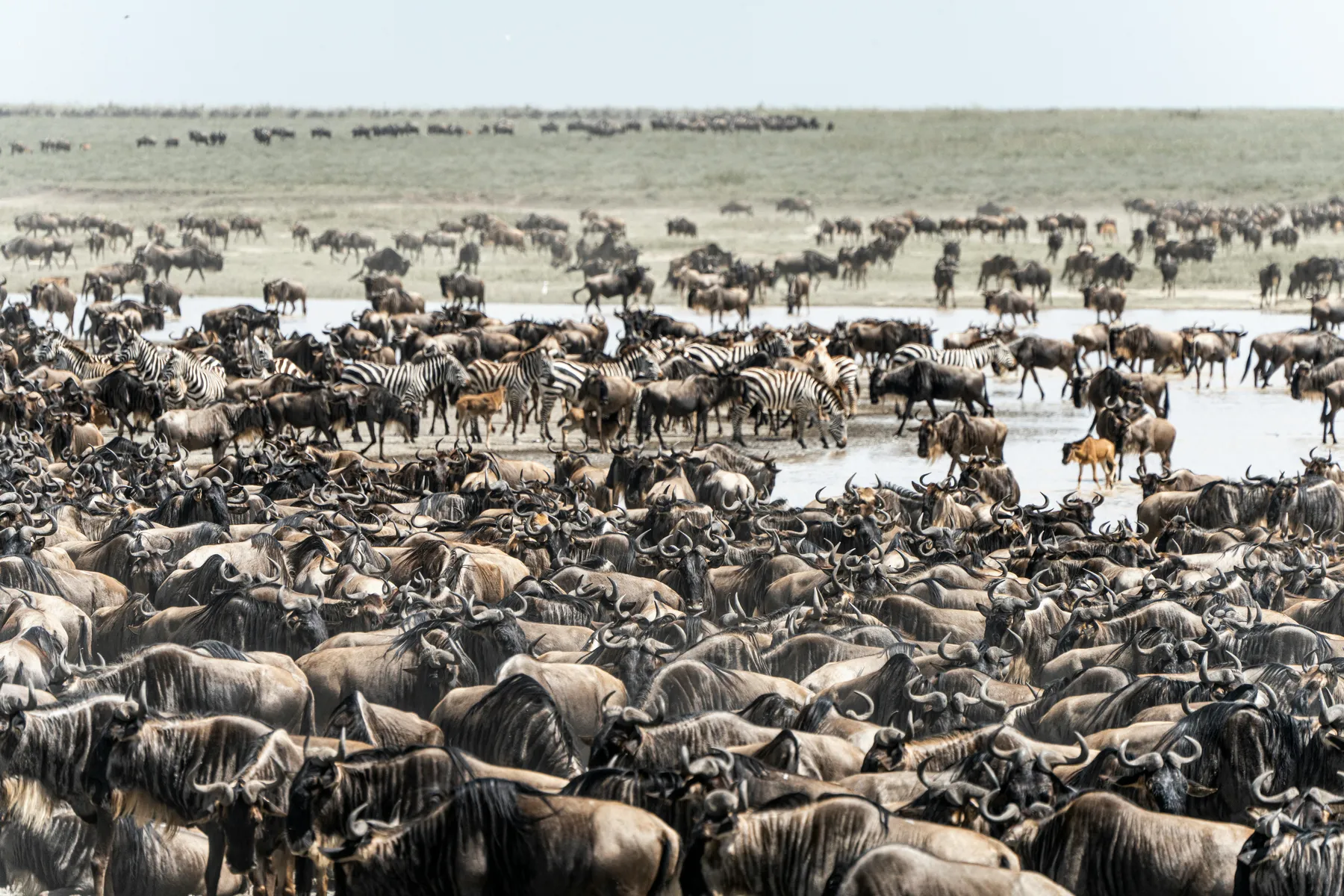
| Following the Herds + Zanzibar | 14 days | Mobile camps positioned with the herds on both sides of the Mara River, then three or four nights on Zanzibar | Travelers whose whole purpose is the river crossings | July–October |
Each route is an illustration we rebuild around your dates, not a package. A gorilla trek in Rwanda or Uganda adds three nights to any of the East African shapes; see Gorillas & Golden Grass.
How to split fourteen nights
| Shape | Nights | Why it works |
|---|---|---|
| Safari + safari + coast | 5 + 5 + 4 | Two distinct wildlife areas at three nights or more each, then the beach; the classic two-week safari |
| City + safari + wonder | 3 + 7 + 3 | Cape Town first (little jet lag from the East Coast), the bush, then Victoria Falls or the Winelands to finish |
| Gorillas + safari + coast | 3 + 7 + 4 | Three nights in gorilla country, a week on the plains, the Indian Ocean to recover |
| One country, slowly | 4 + 4 + 3 + 3 | Tanzania or Kenya alone: four parks at three to four nights each; the least flying, the most time in each place |
What a two-week African safari costs
Our private, tailor-made journeys begin at approximately $12,000 per person, excluding international flights. A two-week itinerary sits above that starting point rather than at it, because each additional safari night carries the camp rate plus per-person park, concession or conservancy fees; beach and city nights usually cost less per night than the bush, which is one reason the safari-plus-coast shape is the most common two-week budget. The season you choose moves camp rates by around 40% between peak and green months; private vehicles, light-aircraft legs and the lodge tier do the rest. Every proposal is itemized, and international flights, visas, insurance and tips sit outside it. How safari costs are built · What Tanzania’s park fees add
When to go for two weeks
June to October suits every shape above and is the only window for the Mara River crossings; January and February give the Serengeti’s calving season and warm, dry Kenya at better value; April and May point you to the Cape, the Falls and the Delta while East Africa is in the long rains. Book ten to twelve months ahead for July to October, a full year for Christmas and New Year, three to six months out for the green season. Safari by month · The month-by-month planner
Two-week safari questions
How much does a two-week African safari cost?
Every journey is priced to your budget. Our private, tailor-made journeys begin at approximately $12,000 per person, excluding international flights; a two-week itinerary sits above that because every safari night adds camp rates and park or conservancy fees. Beach and city nights usually cost less than bush nights, season moves camp rates by around 40%, and every proposal is itemized.
Is two weeks too long for a safari?
No, provided it is not two weeks of game drives. Two wildlife regions at three to five nights each, then three or four nights on a coast or in a city, is the shape that stays fresh to the last day.
How many countries should a two-week safari cover?
One or two. Kenya and Tanzania connect by a short flight; South Africa, Zimbabwe and Botswana connect through Johannesburg. Three countries in fourteen days means too much time in airports.
What is the best two-week safari for a first trip?
The East Africa Circle (Amboseli, a Mara conservancy, the Serengeti and the Ngorongoro Crater) or the Serengeti-to-Zanzibar route for a bush-and-beach finish. South Africa’s Cape, Falls and Delta route suits travelers who want a city and malaria-free options alongside the bush.
Written and reviewed by Evance & Jennifer · Published 5 October 2026