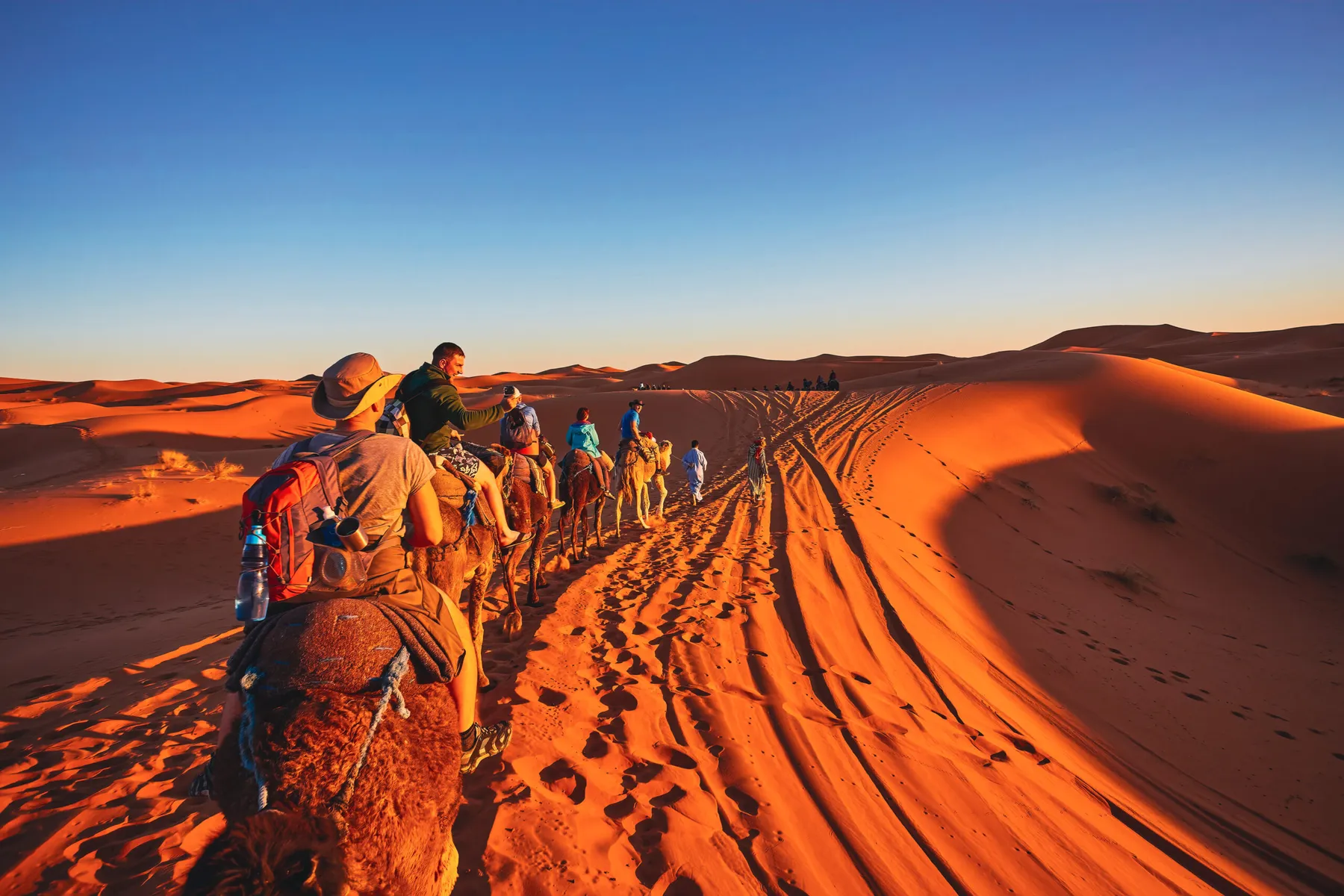
Morocco is Africa at its most sensory — medinas and mint tea, kasbahs and couscous, the snow-capped High Atlas and the silence of the Sahara. It is also the easiest piece of Africa to reach from the USA: about seven hours nonstop to Casablanca.
Our classic route: three nights in a Marrakech riad, a night or two in the High Atlas among Berber villages, then over the mountains to the great dunes of the Sahara for a night in a private luxury camp — candlelit dinner, drums by the fire, and a sea of stars. Fes, Chefchaouen and the Atlantic coast at Essaouira extend the journey beautifully.
Morocco stands alone as a 7–10 day journey, or bookends a longer African trip — Casablanca connects onward across the continent.
Highlights of Morocco
Where you’ll stay in Morocco
Where you stay is selected privately around your journey. We recommend each camp, lodge or villa according to its location, season, guiding, privacy and suitability for the people traveling. Your carefully curated selection will be presented within your tailor-made itinerary.
Plan your private safariKnow before you go
The practical details we handle for you — flights, entry, health and money — summarized here so nothing surprises you. Requirements can change, so we confirm everything when you book.
Royal Air Maroc and United fly nonstop from New York and Washington to Casablanca in about 7 hours — the shortest hop to Africa from the US East Coast — with quick connections to Marrakech.
No visa needed — US citizens enter visa-free for up to 90 days with a passport valid for the length of stay.
What to do in Morocco
Souks, summits and Sahara silence — North Africa’s most seductive country.
Marrakech behind its doors
The Bahia Palace, Jardin Majorelle and the souks with a private guide — then dinner in a candlelit riad courtyard you would never find alone.
Marrakech
Mar–May, Sep–Nov
A night under Sahara stars
Camel or 4x4 into the Erg Chebbi or Erg Chigaga dunes to a private luxury camp — Berber drums by the fire, and a sky with no edges.
Erg Chebbi / Erg Chigaga
Oct–Apr; cold winter nights
The High Atlas and Berber villages
Mule-supported walks between mud-brick villages below Mount Toubkal, with lunch on a kasbah roof terrace an hour from Marrakech.
High Atlas
Apr–Jun, Sep–Oct
Fes, the medieval city
The world’s largest living medieval medina — tanneries, medersas and artisan quarters that have not changed their trades in centuries.
Fes
Mar–May, Sep–Nov
Best time to visit Morocco
Spring — warm days, green valleys and wildflowers in the Atlas.
Autumn — golden light, warm medinas and perfect desert nights.
In the green months rates ease at many of these camps, the plains empty of vehicles and the light turns dramatic. What each season gives, and what it trades, is set out in our Safari Planning Guide.
Planning & cost
Fully tailor-made — priced privately to your camps, season and travel style. No fixed packages.
Fly into Casablanca (CMN) or direct to Marrakech (RAK) via Europe. US citizens enter visa-free for up to 90 days. Private guides and drivers throughout; the desert circuit can also be flown to save road time.
Every journey is privately designed, with private guides and vehicles arranged where specified, the finest lodges, and a specialist on call throughout. At fly-in camps, game drives may be shared unless a private vehicle is reserved.
Practical details,
in one place
Money, health, connectivity and packing work the same way on every safari we plan, so they live in one place rather than on every page.
Continue exploring
Egypt
An Egypt tour takes in the Pyramids, Cairo and a five-star Nile cruise from Luxor to Aswan.
Explore → RegionEastern Africa
An Eastern Africa safari spans the Great Migration, mountain gorillas and the spice islands of Zanzibar.
Explore → RegionSouthern Africa
A Southern Africa safari spans the Okavango Delta, Victoria Falls, the Cape and the dunes of Namibia.
Explore →Morocco FAQs
Getting to Morocco — flights, visas and health
Current at the time of writing. We re-confirm every requirement for your exact routing before you travel — and we will tell you what to apply for, and when.
Let's design your Morocco journey.
Morocco luxury travel moves between medina, mountain and desert, and rewards a slower itinerary.
Tell us how you like to travel and start with a complimentary consultation. When you are ready, a $500 USD planning fee covers your personalized itinerary and revisions, and is deducted from your booking deposit when you book.
Inquire now