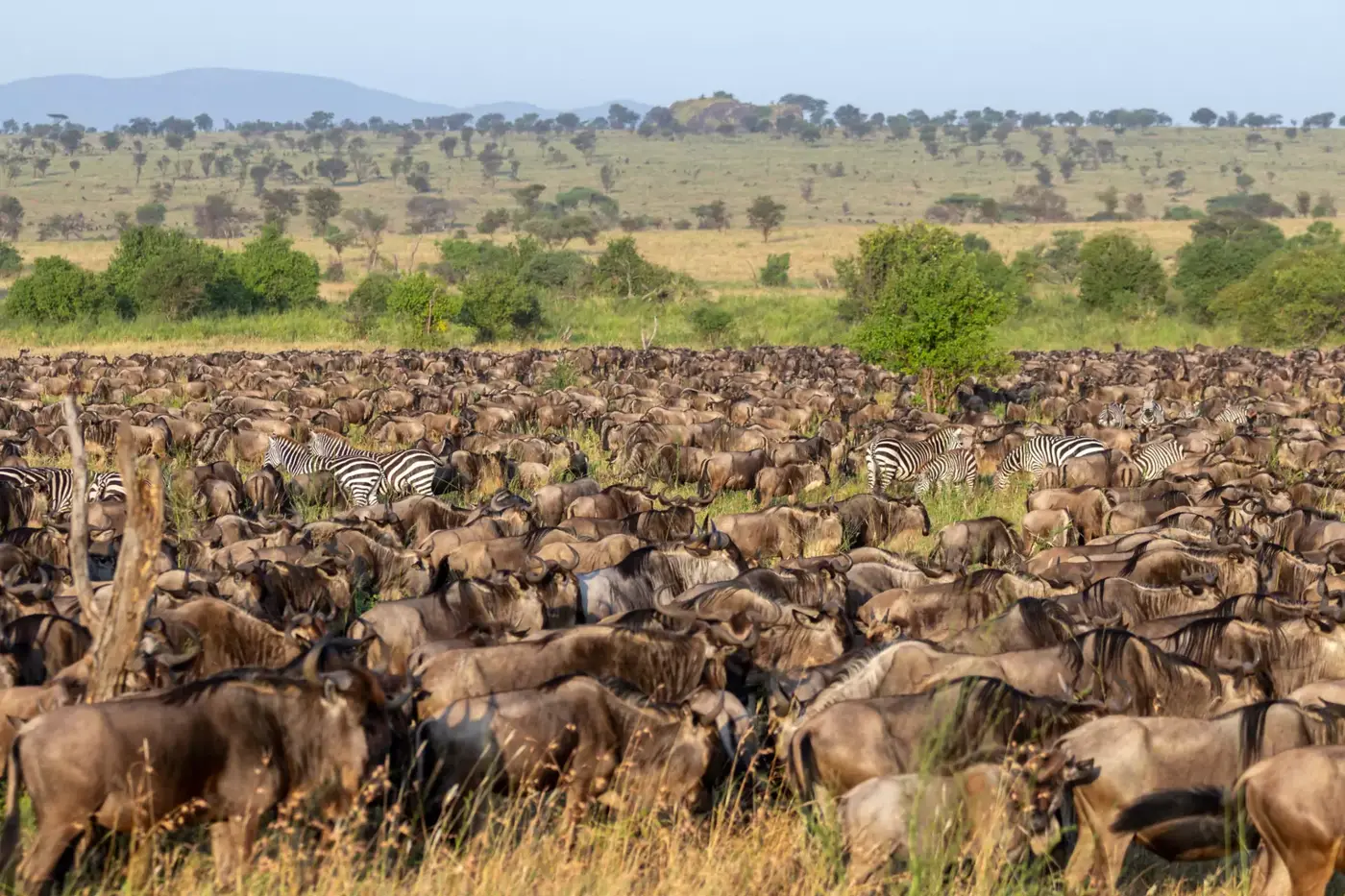
Almost every traveler who asks us about the Great Migration is really asking about one thing: the river. They have seen the photograph — the wall of wildebeest, the brown water, the crocodile. This guide explains what that moment actually involves, when it is most likely, and how to plan a safari around something nobody controls.
What a river crossing actually is
A crossing happens when the herds reach a river on their way north or south and have to get to the other side. Wildebeest gather on the bank, sometimes for hours, sometimes for days. They hesitate, drift along the water’s edge, turn back, build again. Then one animal commits and the rest follow in a torrent.
The whole thing may be over in four minutes or continue in waves for most of an afternoon. Crocodiles work the water; lions and hyenas wait on the far bank. It is the most concentrated piece of drama in the Great Migration, and it is entirely unscheduled.
When do the Mara River crossings happen?
Crossings are most associated with July through October. In a typical year the herds reach the Mara River in the northern Serengeti around July, the busiest crossing activity falls in August on both sides of the river, September sees the herds grazing the Mara’s plains between repeated crossings, and in October they may cross and recross before turning south.
Those are patterns, not dates. Rainfall has become increasingly variable, and the herds respond to grazing rather than to a calendar. A season can run early or late by weeks. Our month-by-month migration calendar sets out where the herds usually are the rest of the year.
The other river: Grumeti crossings in June
The Mara is not the only river the herds meet. June often brings them into the Western Corridor, where crossings of the Grumeti River may occur. These are smaller and far less famous than the Mara crossings, and correspondingly quieter in terms of vehicles. The other great season is calving in the southern Serengeti, from January to March.
For travelers who want crossing drama without August prices and August crowds, June in the Western Corridor is worth a conversation.
Where to watch from: Kogatende, Lamai and the Mara
On the Tanzanian side, the crossing country is the northern Serengeti — the Kogatende and Lamai areas. Camps here are positioned for access to the river, though journey times to any given crossing point vary by camp and by viewing conditions on the day. See Kogatende or Lamai for how to choose between them.
On the Kenyan side, the Maasai Mara offers the same river with the Mara’s resident big cats alongside it. Selected private conservancies allow off-road viewing subject to local rules; different restrictions apply inside the national reserve, which matters more than most travelers expect when a crossing begins several hundred meters from the nearest track.
Neither side is simply better. We compare them honestly in Serengeti vs Masai Mara.
Why no one can promise you a crossing
Be careful with any operator who guarantees a river crossing. Nobody can. The herds decide, and they decide on grazing, rain and instinct rather than on your travel dates.
What a good planner can do is stack the odds: travel inside the likely window, stay in the right area rather than a convenient one, allow enough nights to absorb a slow few days, and use guides who read the river every morning and move early. That is the honest version of the promise, and it is the only one we make.
How many nights you need
Two nights in crossing country is a gamble. Three is a reasonable minimum. Four or five turns a hoped-for sighting into a likely one, and gives you the rest of the ecosystem — the big cats, the plains, the quiet mornings — instead of a single frantic objective.
Travelers who allow ten nights or more can follow the herds across both countries in one journey. Our Great Migration itinerary is built that way.
Planning around the crossings
August is the most requested month of the safari year, and the camps in crossing country are small. Book twelve months or more ahead if August matters to you.
If your dates are flexible, the shoulder weeks at either end of the window — late June into July, or October — often deliver comparable wildlife with fewer vehicles at a sighting. Tell us what you want to see and we will tell you honestly what your dates can and cannot deliver.