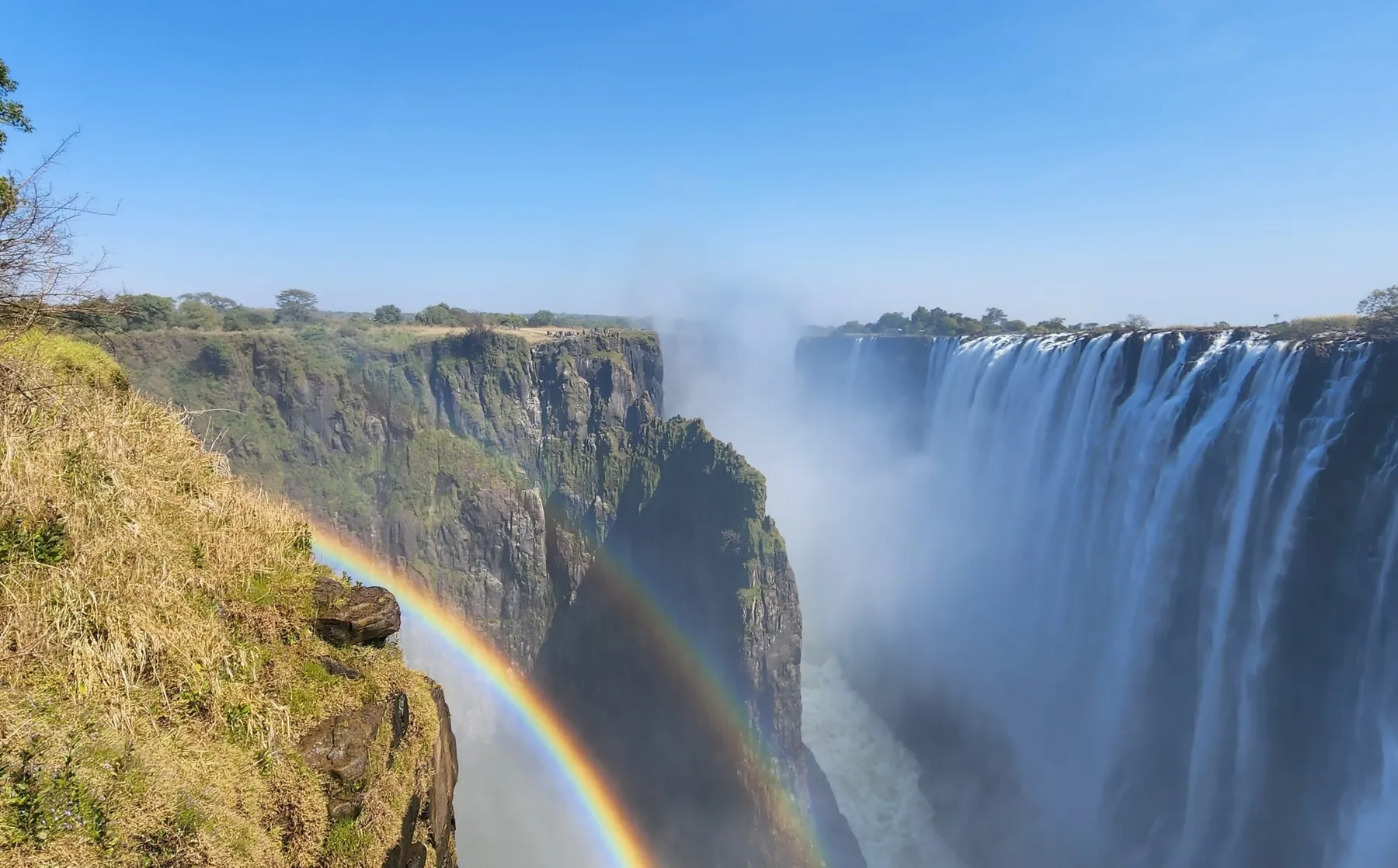
Victoria Falls — known locally as Mosi-oa-Tunya, “the smoke that thunders” — is one of the Seven Natural Wonders of the World and an unmissable addition to any Southern Africa safari.
Straddling Zambia and Zimbabwe, the falls combine effortlessly with Botswana’s Okavango Delta and Chobe for a classic bush-and-falls journey.
Highlights of Victoria Falls
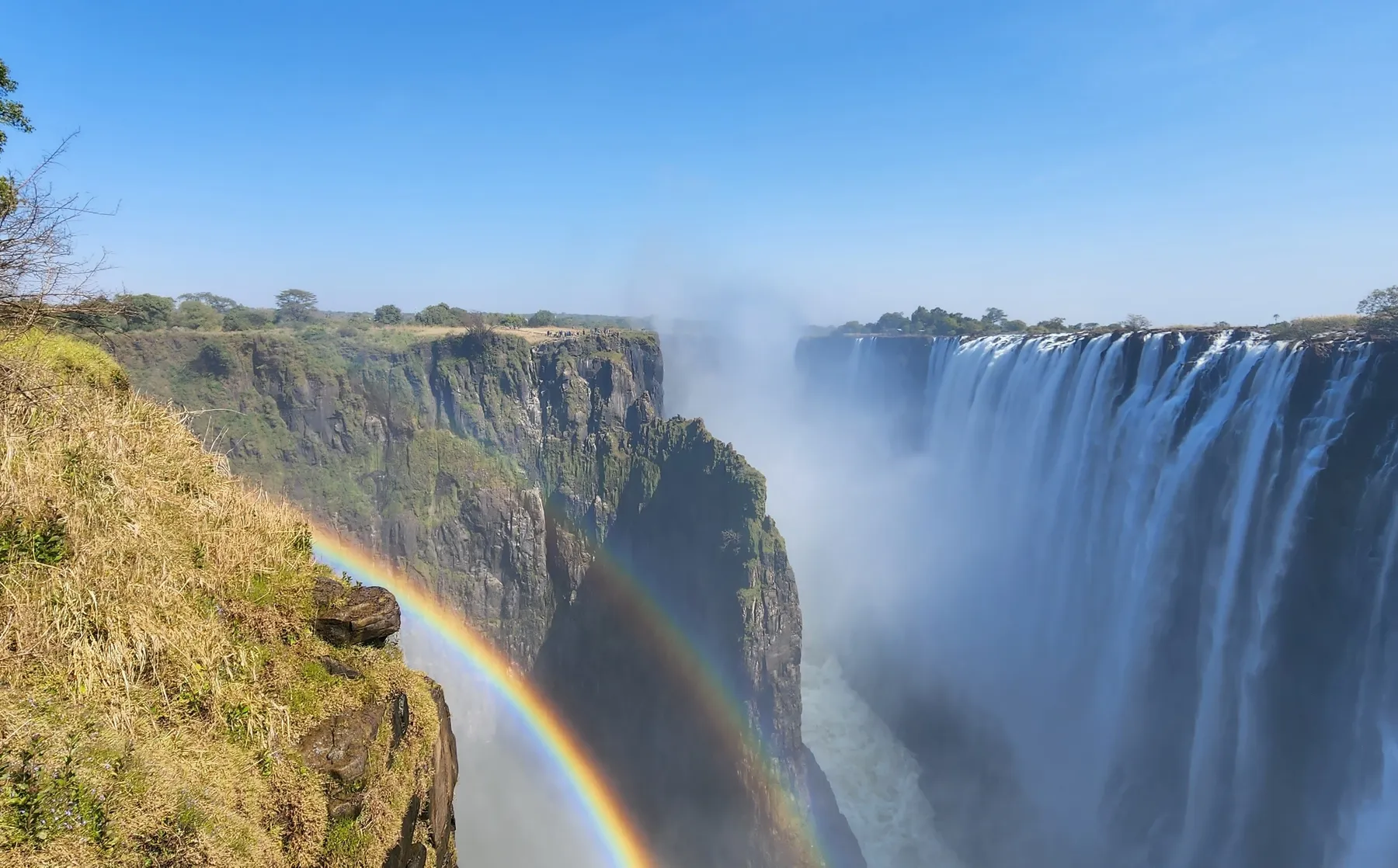
The main falls
Over a kilometer of thundering water and rising spray.
Devil’s Pool
Swim at the very edge of the falls in low-water season (Zambia).
Helicopter flights
The “Flight of Angels” over the gorge and falls.
Zambezi sunset cruise
Sundowners and wildlife on the great river above the falls.
Zambia or Zimbabwe — which side of the Falls?
Victoria Falls straddles two countries and both make a superb base. Here is how they differ, and what to combine with each.
Zimbabwe
The classic panoramic views of the main falls, a historic town, and easy access to Hwange's elephants and the wild Mana Pools.
Explore Zimbabwe → Southern AfricaZambia
Livingstone offers close-up, heart-in-mouth views and Devil's Pool at low water, plus superb walking safaris in South Luangwa.
Explore Zambia → Southern AfricaBotswana
Just up the road: pair the falls with the Okavango Delta and Chobe for the definitive Southern Africa journey.
Explore Botswana →Know before you go
The practical details we handle for you — flights, entry, health and money — summarized here so nothing surprises you. Requirements can change, so we confirm everything when you book.
Fly via Johannesburg to Victoria Falls (Zimbabwe) or Livingstone (Zambia) — about 90 minutes from Joburg. The falls pair naturally with Botswana, Hwange or the Lower Zambezi.
Zimbabwe issues US citizens a visa on arrival (~$30); Zambia is visa-free for US passport holders. The KAZA UniVisa (~$50) covers both sides of the falls.
The falls region is a malaria area — prophylaxis advised. High-water spray season (March–May) soaks the viewpoints; a poncho is provided on tours.
US dollars are widely used in Zimbabwe. Activities are usually pre-booked through us; tipping guides is at your discretion, around $10–20 per activity.
Best time to visit Victoria Falls
Highest water — the most powerful, spectacular curtain of spray.
Low water — clearer views and the Devil’s Pool is open.
In the green months rates ease at many of these camps, the plains empty of vehicles and the light turns dramatic. What each season gives, and what it trades, is set out in our Safari Planning Guide.
Planning & cost
Fully tailor-made — priced privately to your camps, season and travel style. No fixed packages.
Every journey is privately designed, with private guides and vehicles arranged where specified, the finest lodges, and a specialist on call throughout. At fly-in camps, game drives may be shared unless a private vehicle is reserved.
How long to stay, and how the falls change
Most travelers give Victoria Falls two nights. That is enough for a guided walk along the rainforest paths, a sunset cruise on the upper Zambezi and one signature activity: the helicopter flight, Devil’s Pool in low water, or a day trip to Chobe, whose riverfront is under two hours away by road. The Okavango Delta is a short flight further, which is why the falls so often close a Botswana safari.
The falls look completely different through the year. When the Zambezi is in flood, roughly March to May, the spray rises so high that the viewpoints are drenched and the curtain of water is often veiled in mist. Toward the end of the year the river drops; parts of the Zambian side can run almost dry, the basalt face is exposed, and the Zimbabwean side keeps the fullest flow. Neither is better, only different: high water is about power, low water about clear views and Devil’s Pool.
Around full moon in the high-water months, the spray can form a lunar rainbow, and the rainforest paths open for evening visits to see it. If your dates allow, we time your nights to catch one.
Practical details,
in one place
Money, health, connectivity and packing work the same way on every safari we plan, so they live in one place rather than on every page.
Continue exploring
Zimbabwe
A Zimbabwe safari runs from Victoria Falls to Hwange’s elephants and the wild canoeing of Mana Pools.
Explore → Southern AfricaZambia
A Zambia safari means the home of the walking safari — and the Zambian side of Victoria Falls.
Explore → Southern AfricaBotswana
A Botswana safari is Africa’s water wilderness — the Okavango Delta, Chobe and the Kalahari.
Explore → RegionSouthern Africa
The desert, the delta and the falls — Botswana, Namibia, Zambia, Zimbabwe and South Africa.
Explore →Victoria Falls FAQs
Getting to Zimbabwe — flights, visas and health
Current at the time of writing. We re-confirm every requirement for your exact routing before you travel — and we will tell you what to apply for, and when.
Let's design your Victoria Falls journey.
A Victoria Falls safari works as a hinge between two countries, not simply a viewpoint.
Tell us how you like to travel and start with a complimentary consultation. When you are ready, a $500 USD planning fee covers your personalized itinerary and revisions, and is deducted from your booking deposit when you book.
Inquire now