A hot-air balloon safari costs USD 599 per person in the Serengeti, USD 550 in Tarangire and USD 430 plus a USD 50 reserve fee in the Maasai Mara, according to the prices the operators themselves publish, checked on 5 October 2026. For that you get a transfer from camp in the dark, roughly an hour in the air as the sun comes up, and a champagne bush breakfast where you land. This guide sets out exactly what the price covers, who is allowed to fly, where and when flights operate, and our honest view on when the dawn start is worth it.
Balloon safari prices in 2026
| Where | Operator | Published price per person | Launch sites and season |
|---|---|---|---|
| Serengeti, Tanzania | Serengeti Balloon Safaris | USD 599, fully inclusive package, shared balloon | Central Serengeti all year; Western Corridor and northern Serengeti June to October; Ndutu 20 December to 31 March |
| Serengeti, Tanzania | Miracle Experience | USD 599 rack rate | Seronera all year; seasonal bases following the migration |
| Tarangire, Tanzania | Miracle Experience | USD 550 rack rate | Tarangire National Park |
| Maasai Mara, Kenya | SkyShip Company | USD 430 + USD 50 reserve conservation fee; children 4 – 12 USD 215 + USD 25 | Maasai Mara National Reserve |
| Maasai Mara, Kenya | Governors’ Balloon Safaris | Published through the operator’s booking page | Musiara area, Maasai Mara |
Sources: Serengeti Balloon Safaris, Miracle Experience FAQ and SkyShip Company rates, all read on 5 October 2026. Operators revise prices, usually at the start of a season; your proposal carries the rate confirmed for your date.
Two government charges sit inside these prices. In the Serengeti, TANAPA levies a balloon operation fee of USD 50 per person per flight, which the operators build into their rate alongside 18% VAT; our Tanzania park fees guide lists it. In the Maasai Mara, the Narok County Finance Act sets a balloon single-landing fee per passenger, which the operators collect as the separate conservation fee shown above; see our Maasai Mara park fees guide.
What the price includes
- The transfer. A vehicle collects you from camp before first light, typically between 4:30 and 5:30 a.m. depending on the distance to the launch site, and returns you to camp or to your guide afterwards.
- The flight. Around an hour in the air, drifting with the wind at anything from treetop height to several hundred meters. Baskets are shared with other guests and divided into compartments; private baskets can sometimes be arranged at a premium.
- The breakfast. A full bush breakfast laid out where the balloon lands, with sparkling wine, the balloonists’ tradition since the first flights. Miracle Experience also lists a flight certificate and Wi-Fi.
- Fees and tax. The park balloon fee and VAT are inside the Serengeti and Tarangire prices; the Mara reserve fee is added separately.
What it does not include: gratuities for the pilot and ground crew, which are at your discretion, and the game drive you would otherwise have had that morning. Most guests go on a short drive on the way back to camp.
Who can fly
Each operator sets its own rules. Miracle Experience publishes a minimum height of 1.2 meters (3 ft 11 in), allows children aged five to seven only with a responsible adult, adds a supplement for passengers over 120 kg (265 lb) because of basket weight limits, and does not fly pregnant travelers. SkyShip in the Mara publishes a child rate for ages 4 to 12. Everyone must be able to climb into a basket roughly chest-high with no door, and to crouch and hold on for a landing that can be bumpy; we discuss this honestly with older guests and anyone with limited mobility, and our accessible safari guide goes further.
When and where flights happen
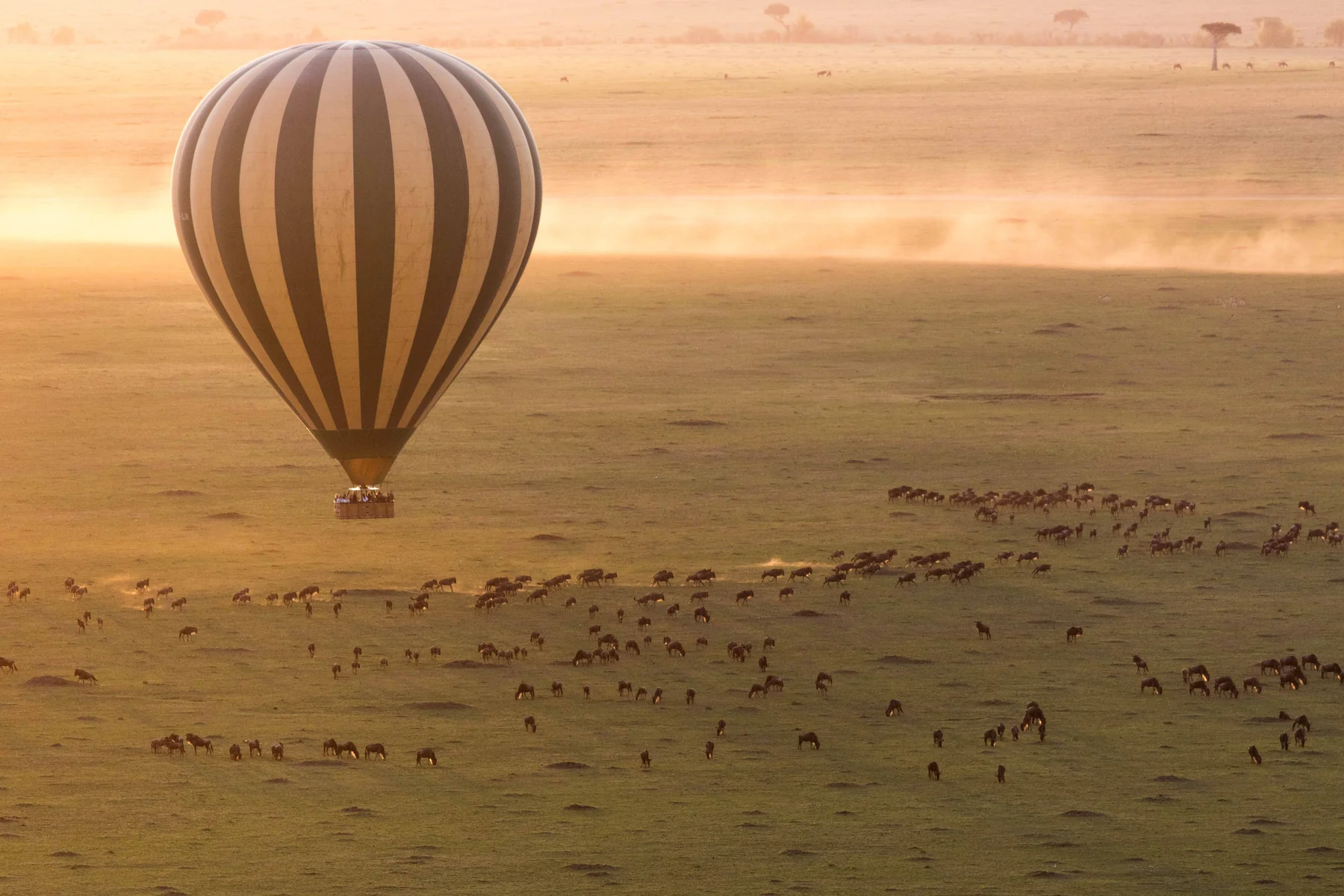
Balloons fly at dawn only, when the air is still. In the Serengeti the central Seronera area flies all year; the operators move seasonal bases to follow the migration, with the Western Corridor and the northern Serengeti from June to October and Ndutu from late December to March, so a flight can be placed over the herds for most of the year. The Maasai Mara flies year-round, with the river-crossing months of July to October the most sought after. Tarangire is a quieter, elephant-rich alternative with a lower price. Our safari-by-month guide shows where the herds are in each month.
Wind cancels flights, and the pilot decides at the launch site. We therefore never book a balloon for the morning you leave a camp or the morning of a flight to the coast; a flight in the middle of a three- or four-night stay can be rebooked for the next dawn if the first one is called off.
Is a balloon safari worth it?
Once, for almost everyone. The silence after the burners cut out, the shadow of the balloon crossing the plain, and the view of the land as the animals see it are unlike anything else on a safari. It is also the single most popular setting for a proposal, which we cover in our safari proposal ideas. What it is not is a replacement for a game drive: you see patterns and landscape rather than close encounters, and a good guide on the ground will show you more individual animals in the same hour. On a safari that begins at approximately $12,000 per person, a USD 599 flight is a modest line; we include it when the dates put the herds beneath you, and we say so when they do not.
Balloon safari questions
How much does a hot air balloon safari cost in the Serengeti?
USD 599 per person in a shared balloon, the rack rate published by both licensed Serengeti operators, Serengeti Balloon Safaris and Miracle Experience, as of 5 October 2026. The price includes the transfer from your camp, the flight of around an hour, a bush breakfast after landing, the park’s balloon fee and VAT.
How much is a balloon safari in the Maasai Mara?
SkyShip Company publishes USD 430 per adult plus a USD 50 reserve conservation fee, and USD 215 plus USD 25 for children aged 4 to 12. Governors’ Balloon Safaris publishes its rates through its booking page. Mara flights also end with a champagne bush breakfast.
Is a balloon safari worth the money?
For most travelers, once. An hour drifting silently over the plains at sunrise is unlike anything else on safari, and in migration season the herds below are extraordinary. It is not a wildlife-viewing substitute for a game drive: you see the landscape and the pattern of animals rather than close encounters.
Can children go on a balloon safari?
Yes, with rules set by each operator. In the Serengeti, Miracle Experience requires a minimum height of 1.2 meters and allows children aged five to seven only with an accompanying adult. SkyShip in the Mara publishes a child rate for ages 4 to 12. Pregnant travelers are not permitted to fly.
What happens if the balloon flight is cancelled for weather?
The pilot decides at the launch site at dawn. If wind or visibility rules out the flight, the operator refunds or rebooks, which is why we place a balloon in the middle of a stay rather than on the last morning.
Written and reviewed by Evance & Jennifer · Published 5 October 2026 · Prices checked 5 October 2026