Staying healthy on safari is largely a matter of a few simple, well-understood precautions. Requirements vary by country and itinerary, so always confirm with a travel clinic or your doctor six to eight weeks before you travel. This guide explains the essentials so you arrive prepared — not anxious.
This is general information, not medical advice. We confirm the exact requirements for your specific route before you go.
The short answer
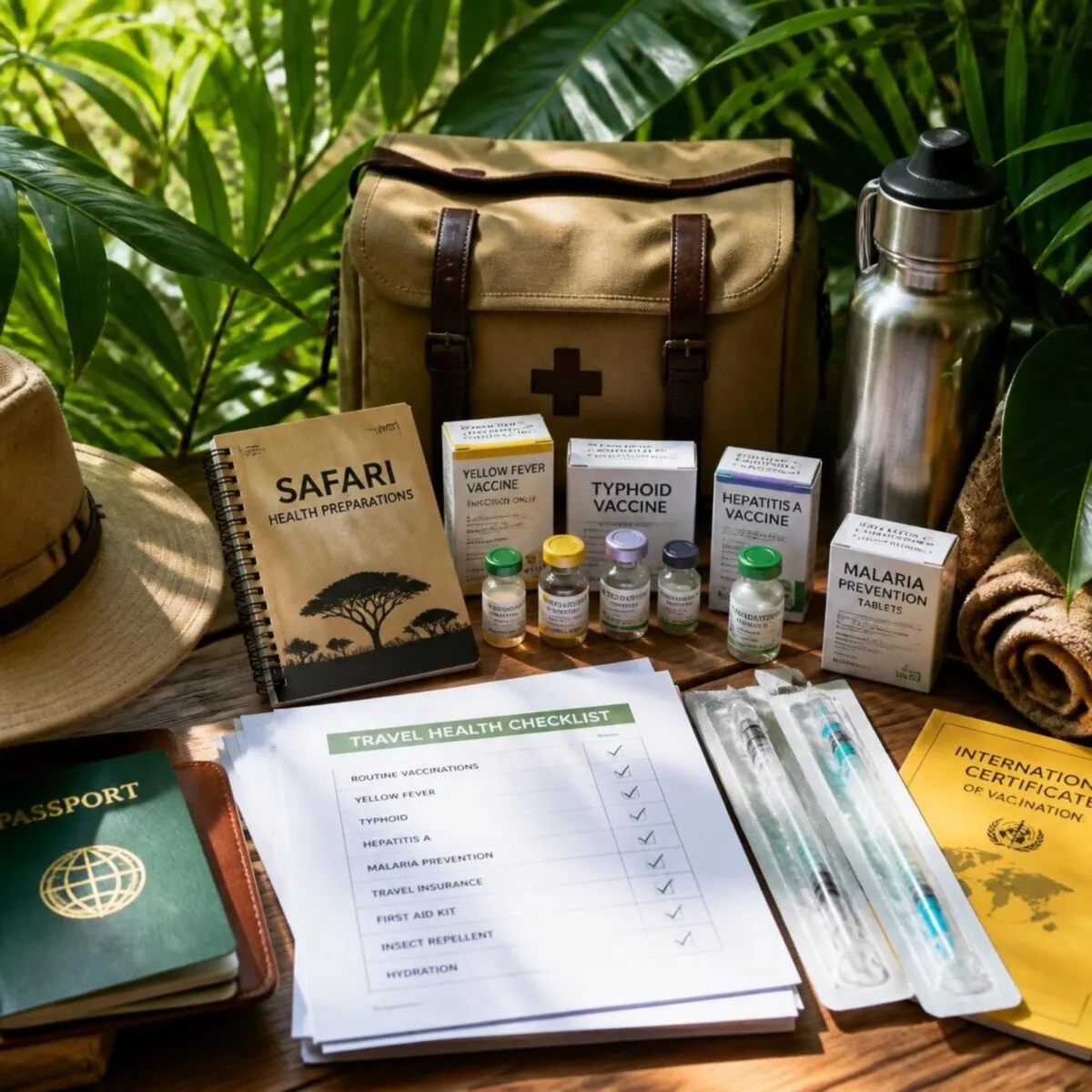
For a US traveler flying directly, no vaccine is required for entry to Kenya, Tanzania, Rwanda, South Africa or Botswana; Uganda requires a yellow fever certificate from every arriving traveler aged one year and over. Everywhere else the yellow fever certificate becomes a requirement only if you arrive from, or spend more than twelve hours in transit through, a country with yellow fever risk. Uganda, Rwanda and Ethiopia count, so a gorilla trek followed by Kenya or Tanzania, or a long connection in Addis Ababa, means you will need the certificate. Recommended is a different list: routine vaccines, hepatitis A and typhoid for most travelers, and malaria tablets for nearly every safari area. Confirm your own list with a travel clinic six to eight weeks before departure.
| Country | Yellow fever certificate (US traveler) | Malaria | Source |
|---|---|---|---|
| Kenya | Not required from the US; required if arriving from a risk country. | Recommended below 2,500 m, which covers the safari areas; not central Nairobi. | CDC Kenya |
| Tanzania and Zanzibar | Not required from the US; required if arriving from a risk country or after a transit of more than 12 hours in one. | Recommended in all areas below 1,800 m, including the parks and Zanzibar. | CDC Tanzania |
| Uganda | Required for all arriving travelers aged 1 year and over. | Recommended throughout the country. | CDC Uganda |
| Rwanda | Required if arriving from a risk country. | Recommended throughout the country. | CDC Rwanda |
| South Africa | Required if arriving from a risk country. | Seasonal risk in Kruger and Sabi Sand; Madikwe and the Eastern Cape reserves are malaria-free. | CDC South Africa |
| Botswana | Required if arriving from a risk country. | Recommended for the Okavango and Chobe, chiefly November to June. | CDC Botswana |
Checked against the CDC destination pages on 13 September 2026; requirements change, so we re-confirm them for your route when we issue your travel documents. See also planning essentials and what to pack.
Malaria
Much of the safari region is a malaria area, so antimalarial tablets are usually recommended, alongside insect repellent, long sleeves at dusk and the mosquito nets every camp provides. Your doctor will advise the right tablets for you. Good to know: several South African reserves are malaria-free, a reassuring option for families with young children.
Yellow fever
Some countries require proof of yellow-fever vaccination — recorded on the international certificate — particularly if you are arriving from, or transiting through, a country where the disease is present. The rules depend on your full routing, so this is one to check carefully for your specific itinerary.
Routine & recommended vaccines
Travel clinics commonly suggest making sure routine vaccinations are up to date and considering a few others for the region.
- —Up-to-date routine vaccines (e.g. tetanus, measles, polio)
- —Hepatitis A and typhoid — commonly recommended
- —Yellow fever — where required by your route
- —Others (e.g. hepatitis B, rabies) per your clinic’s advice
Food, water & everyday health
Drink bottled or filtered water — provided at every camp — rather than tap water, and you can enjoy the food with confidence at luxury lodges. Bring any personal medication in your carry-on, plus a small kit with sunscreen, lip balm, rehydration sachets and anything you rely on. We also strongly recommend comprehensive travel insurance that includes medical evacuation. Planning a safari in your 60s, 70s or 80s? See our guide to African safaris for seniors.