By Evance and Jennifer, Co-Founders of NndeeAfrika | Updated August 2026
Knowing what to pack for an African safari is mostly a matter of restraint. Camps offer same-day laundry, light aircraft impose real luggage limits, and the clothes that work best are the quiet, breathable ones you already own. Here is the packing list we send our own guests — what earns its place, and what stays home.
Prefer a one-page version to tick off? Open the printable safari packing checklist. Luggage rules differ by airline and camp, and we confirm the exact limits for your flights in your travel documents.
A refined list for 7–10 days
Assume laundry every second day and you travel remarkably light. This is the core of a luxury safari packing list — enough for a week or ten days across two or three camps.
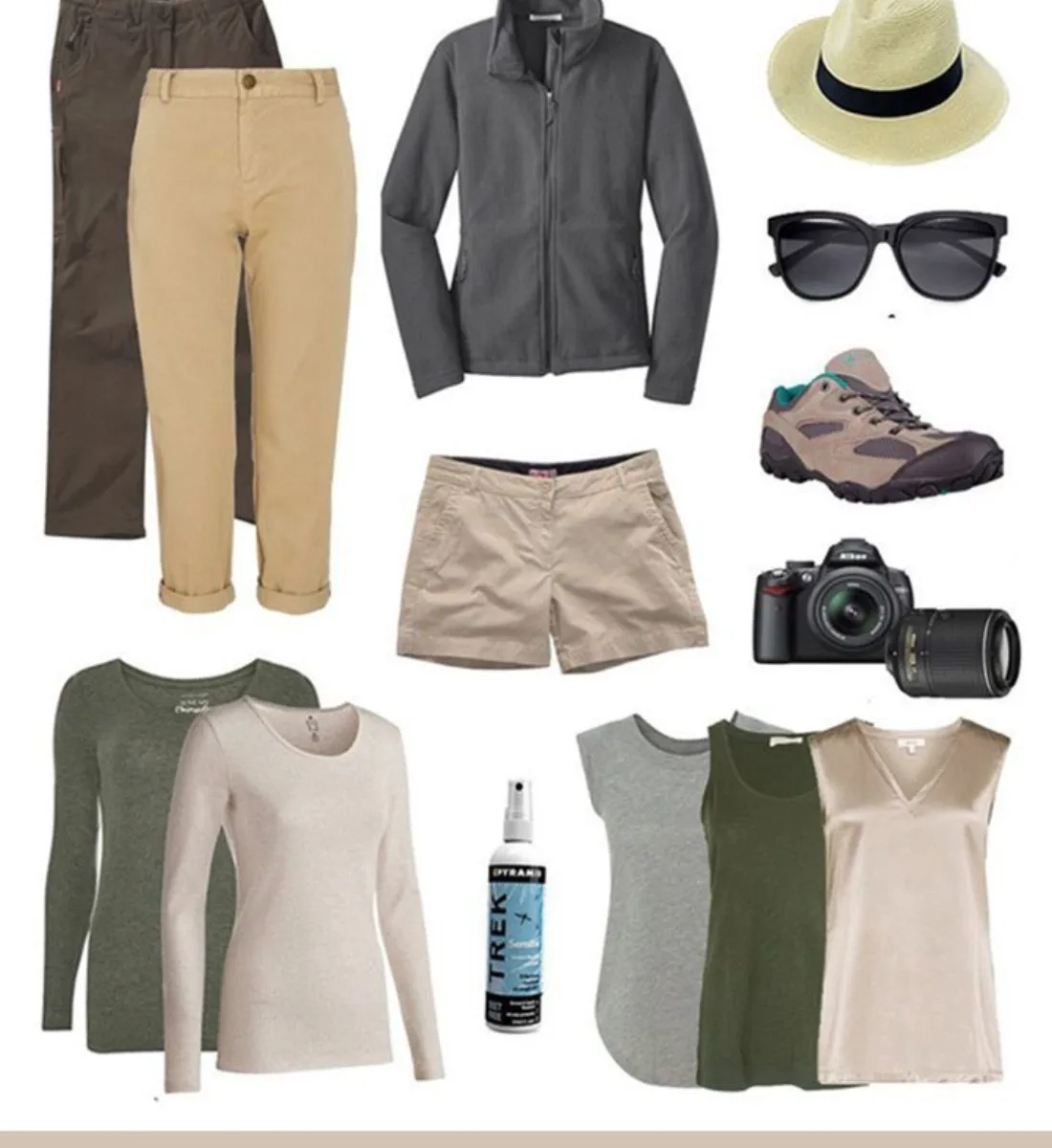
- —Three or four pairs of lightweight trousers, one of which converts or dries fast
- —Four or five breathable shirts — long sleeves for sun and evening insects, short for midday
- —One warm fleece or wool layer and a windproof jacket for cold morning drives
- —A wide-brimmed hat, polarized sunglasses and a light scarf or buff for dust
- —Swimwear, sleepwear and enough underwear and socks for four or five days
- —One smart-casual outfit for dinners, city hotels or a beach extension
Clothing, layers and colors
Neutral khaki, olive, tan, stone and muted green are the practical choice: they hide dust, suit every camp and matter most on walking safaris, where blending into the surroundings is part of the discipline. White looks crisp for about an hour before the dust finds it. Dark blue and black are best avoided in regions where tsetse flies occur, as those colors are known to attract them.
The real skill is layering: a drive can start near freezing in an open vehicle and be hot by mid-morning, so wear pieces you can shed. Long sleeves and trousers in the evening are as much about insects as warmth.
A Safari Color Guide
Camouflage clothing is restricted or culturally inappropriate in some African destinations — we flag the rules for your specific route.
Neutral shades are practical, photograph beautifully and are especially appropriate for walking safaris. On vehicle-based game drives, comfort and layering matter more than dressing entirely in khaki. Color recommendations may vary according to the destination and activity.
Footwear
Ordinary vehicle safaris do not require hiking boots. Comfortable closed-toe shoes or trainers are normally sufficient, with sandals for camp and a pair of easy slip-ons for flights. Broken-in waterproof boots with ankle support are the right choice for gorilla trekking and specialist walking safaris — and they must be broken in before you travel, never bought new for the trip.
Light-aircraft luggage
Where light-aircraft flights are included, a flexible soft-sided duffel is usually the safest choice. Allowances commonly range from 15–20 kg (33–44 lb) per person, including hand luggage and camera equipment, but the exact weight, dimensions and wheeled-bag rules depend on the airline, aircraft and route. NndeeAfrika confirms the applicable allowance for every journey before departure.
Keep documents, medication and one change of clothes in your carry-on, and leave hard-shell cases at home — small holds are shaped for soft bags that yield.
Game drives, cameras and electronics
Binoculars are the most underrated item on any African safari packing list — 8x42 or 10x42, one pair each rather than one to share. Bring spare memory cards and batteries, a dust blower and a lens cloth; charging is available in every camp we use, sometimes only in the main areas.
- —Power banks and spare lithium batteries must travel in carry-on baggage and are subject to airline capacity rules
- —A universal adapter, and a plug type check per country — East and Southern Africa differ
- —A beanbag or soft support beats a tripod in a vehicle; see our photographic safaris for equipment planning
- —Do not bring a drone without advance written authorization — most parks prohibit them outright, and confiscation at arrival is common
Health, medication and documents
Health and entry requirements vary by traveler, destination and route. Consult a qualified physician or travel-medicine clinic well before departure regarding vaccinations, malaria prevention and individual medical needs. Carry essential prescription medication in its original labeled packaging and keep it in your hand luggage. Many African destinations require sufficient passport validity and blank pages, while visas, electronic travel authorizations and yellow-fever certificates depend on the itinerary. NndeeAfrika confirms the relevant entry and airline requirements before travel but does not provide medical advice.
- —A small personal kit: any prescriptions, pain relief, rehydration salts, plasters, antiseptic and hand sanitizer
- —High-SPF sunscreen and lip balm — the sun is stronger than most first-time visitors expect
- —An EPA-registered insect repellent, used exactly as its label directs
- —Printed and digital copies of passports, insurance and your itinerary, stored separately
Packing for families with young children
A family safari asks for a little more thought and surprisingly little more luggage. The safari packing list for kids is mostly about comfort, sun and the hours between camps.
- —Child-sized sun hats and UV-protective sunglasses, plus long-sleeved sun-protective layers
- —A full change of clothes for each child in your hand luggage, not the hold
- —Familiar medications in their original packaging, and any comfort item that helps at bedtime
- —Wipes, a reusable water bottle and quiet activities for flights and transfers
- —An age-appropriate EPA-registered insect repellent, used exactly according to its label — products containing oil of lemon eucalyptus or PMD are not recommended for children under three
- —Children’s passports stay with you; confirm early whether birth certificates or consent documents are required for your route
- —For babies and toddlers, ask us whether a soft carrier will be more practical than a stroller at your chosen camps — on sand, boardwalks and bush paths it usually is
Honeymoons, celebrations and lodge evenings
Safari camps are relaxed and formalwear is rarely necessary — dinner is often outdoors, in what you wore at sundowners. For honeymoon dinners, private celebrations, luxury trains, city hotels or beach resorts, one lightweight smart-casual outfit each is enough, with an elegant wrap or light jacket for cool evenings, swimwear and suitable resort wear. Leave irreplaceable jewelry at home; it has no role on safari and every camp safe is a compromise.
Gorilla-trekking essentials
A day in the Virungas or Bwindi is wetter, steeper and muddier than the rest of your journey, and the kit list changes accordingly. See gorilla trekking for how we plan the trek itself.
- —Broken-in waterproof boots with ankle support, and gaiters if you have them
- —Lightweight waterproof jacket and quick-dry trousers — rain is possible in any month
- —Gardening-weight gloves for grabbing vegetation on steep, stinging slopes
- —A dry bag or rain cover for camera gear, and a small daypack for water and layers
- —Long sleeves and tucked-in trousers against nettles and ants
Safari-and-beach extensions
If your journey finishes on the coast — Zanzibar, the Seychelles, Mauritius or Mozambique — pack the beach half separately and keep it light: swimwear, resort wear, reef-safe sunscreen and a sun shirt for snorkeling. Camps launder everything before you leave the bush, so you arrive at the sea with a clean bag. Our beaches and islands pages set out which island suits which season.
What not to pack
- —Camouflage clothing — restricted or prohibited for civilians in several African countries
- —Single-use plastic carrier bags — banned in Kenya, Rwanda, Tanzania and elsewhere in East Africa, with real penalties
- —Drones, unless you hold advance written authorization for every park on your route
- —High-wattage hair dryers and heavy styling tools — remote camps run on solar and inverters and may not support them; most provide a dryer where power allows
- —Hard-shell suitcases, formal shoes, and more clothing than four days’ worth — laundry is included nearly everywhere
Frequently asked questions
How much luggage can I take on a safari?
Where light aircraft are involved, allowances commonly range from 15–20 kg (33–44 lb) per person including hand luggage and camera gear, in a soft-sided duffel. The exact figure depends on the airline, aircraft and route — we confirm yours before departure.
What colors should I wear on safari?
Neutral khaki, olive, tan, stone and muted green are the most practical, and they matter most on walking safaris. White shows dust quickly, and dark blue and black are best avoided where tsetse flies occur.
Do I need hiking boots for a safari?
Not for ordinary vehicle safaris — comfortable closed-toe shoes or trainers are normally sufficient. Broken-in waterproof boots are appropriate for gorilla trekking and specialist walking safaris.
What should I pack for children on safari?
Sun hats, UV-protective sunglasses, sun-protective layers, a change of clothes in hand luggage, familiar medications in original packaging, wipes, a reusable bottle, a comfort item and quiet activities for transfers.
Is there laundry at safari camps?
Almost always, and usually same-day, which is why four or five days of clothing is enough for a two-week journey. Some camps ask that underwear be laundered by guests; a little travel wash covers it.
Every NndeeAfrika guest receives final packing guidance matched to the season, camps, internal flights and activities included in their private itinerary.