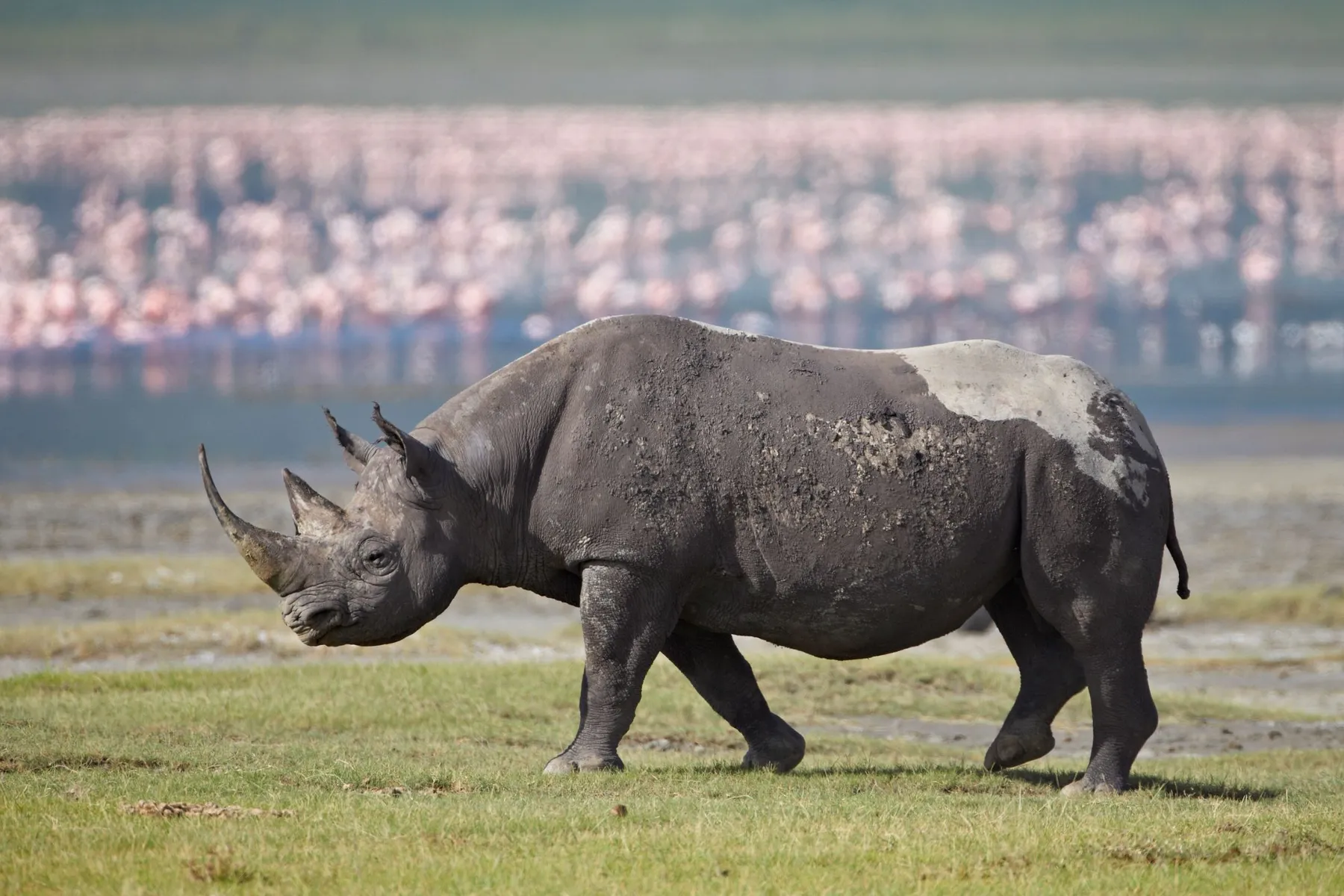
Africa has two rhino species, and neither is named for its color. The white rhino — a mistranslation of the Dutch “wijde” (wide) — is a square-lipped grazer of open grassland, heavier and calmer, often weighing more than 2 tons. The black rhino is a hook-lipped browser of thicket, smaller, more solitary and famously feistier.
Poaching brought both to the brink — which is why seeing a rhino today is inseparable from conservation. The sanctuaries doing the work, from Kenya’s Lewa to South Africa’s private reserves, are precisely where sightings are best, and where your safari directly funds the rangers who keep them alive.
Highlights of the rhinoceros
White rhino
Square-lipped grazer of open grassland — often over 2 tons, calmer, often in small groups called crashes.
Black rhino
Hook-lipped browser of dense thicket — smaller, solitary and famously quicker to charge.
Senses & speed
Poor eyesight but exceptional smell and hearing — and despite the bulk, a rhino can reach about 30mph.
Horn & behavior
The horn is keratin — the same as fingernails — regrowing through life and used in defense and display.
A conservation story
Fewer than 25,000 remain in Africa — sanctuaries and private reserves are why numbers are rising in places.
Where to see them
Lewa and Ol Pejeta in Kenya, the Ngorongoro Crater’s black rhino, and South Africa’s private reserves.
Explore Where to see them →Best time to see rhino
Dry season — rhinos hold to water points and shorter grass improves viewing.
On fenced, protected sanctuaries like Lewa, sightings are possible in every month.
In the green months rates ease at many of these camps, the plains empty of vehicles and the light turns dramatic. What each season gives, and what it trades, is set out in our Safari Planning Guide.
Planning & cost
Fully tailor-made — priced privately to your camps, season and travel style. No fixed packages.
Every journey is privately designed, with private guides and vehicles arranged where specified, the finest lodges, and a specialist on call throughout. At fly-in camps, game drives may be shared unless a private vehicle is reserved.
Practical details,
in one place
Money, health, connectivity and packing work the same way on every safari we plan, so they live in one place rather than on every page.
Continue exploring
Big Five Safari
A Big Five safari — lion, leopard, elephant, buffalo and rhino, Africa’s most sought-after sightings.
Explore → ExperiencePrivate Conservancies
A private conservancy safari — fewer vehicles, wilder freedom, and safaris that fund the land they cross.
Explore → TanzaniaNgorongoro Crater
The Ngorongoro Crater — the Big Five inside a collapsed volcano, some of the densest game viewing in Africa.
Explore →The Rhinoceros FAQs
Let's design your Rhinoceros journey.
Tell us how you like to travel and start with a complimentary consultation. When you are ready, a $500 USD planning fee covers your personalized itinerary and revisions, and is deducted from your booking deposit when you book.
Inquire now