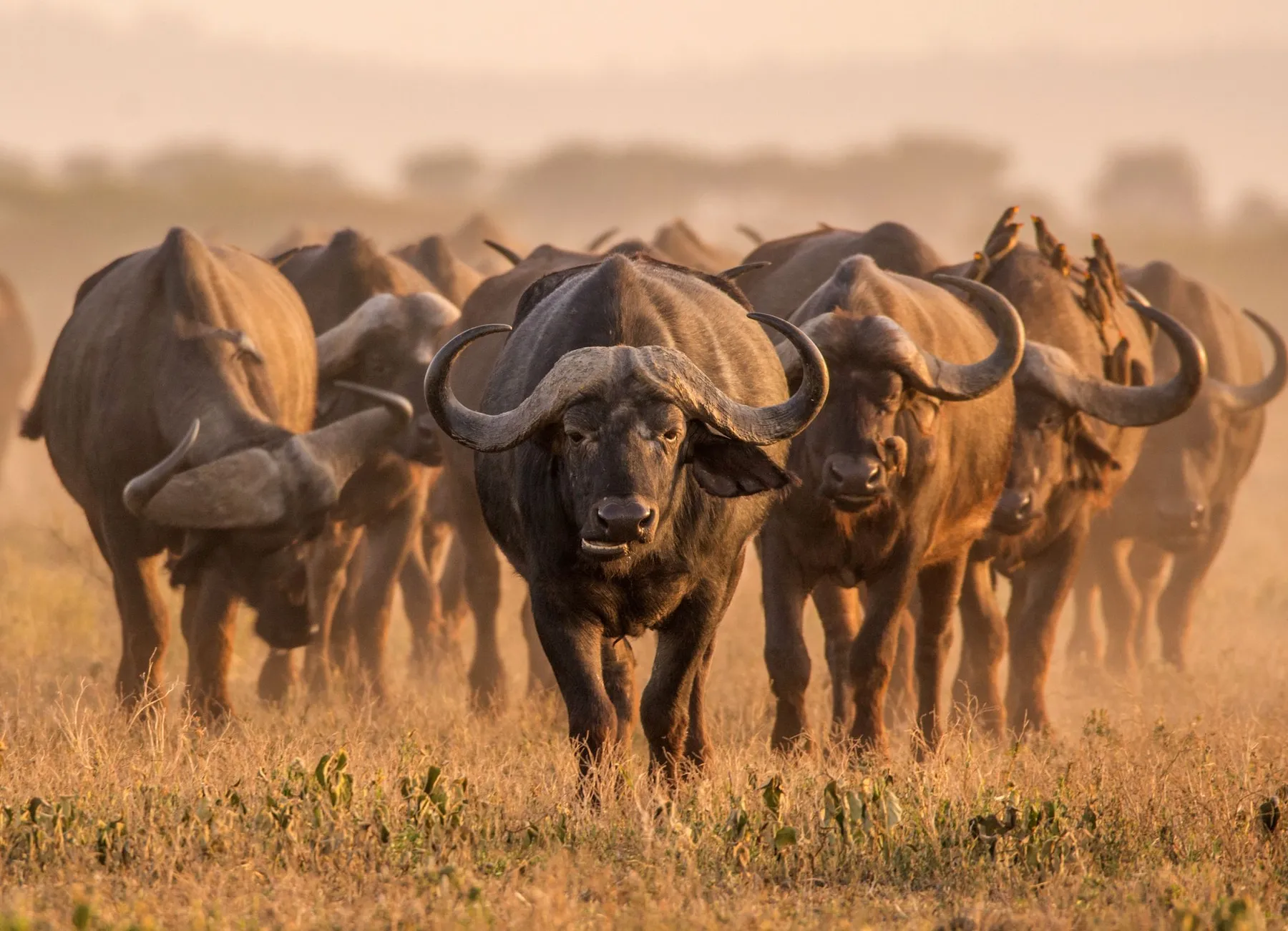
The Cape buffalo earned its Big Five place the hard way: old hunters called it “the widowmaker,” and guides still treat it with more respect than any predator. Weighing up to 1,900lbs with fused horn bosses like a battle helmet, a buffalo fears almost nothing — herds will turn and mob lions that attack them.
Most buffalo live in breeding herds hundreds or even thousands strong, moving between grazing and water in a slow, dust-raising tide. The old bulls that leave the herd — “dagga boys,” named for the mud they wallow in — live in small bachelor groups and are the reason walking guides carry rifles.
Highlights of the Cape buffalo
Built like a tank
Up to 1,900lbs, with fused horn bosses forming a shield — old hunters called it “the widowmaker.”
Strength in numbers
Breeding herds can top a thousand — they defend calves collectively and even mob attacking lions.
Herd democracy
Females literally vote on travel direction — standing, facing their preferred way, then moving as one.
Dagga boys
Old bulls caked in mud, short on patience — the animal walking guides respect most.
Never truly tamed
Unlike its Asian cousin, the Cape buffalo has never been domesticated — unpredictable and fearless.
Where to see them
The Serengeti, Katavi’s 1,000-strong herds, the Okavango and Kruger all offer superb buffalo viewing.
Explore Where to see them →Best time to see Cape buffalo
Dry season — huge herds concentrate on rivers and remaining water.
Buffalo are non-migratory in most parks and seen reliably in every season.
In the green months rates ease at many of these camps, the plains empty of vehicles and the light turns dramatic. What each season gives, and what it trades, is set out in our Safari Planning Guide.
Planning & cost
Fully tailor-made — priced privately to your camps, season and travel style. No fixed packages.
Every journey is privately designed, with private guides and vehicles arranged where specified, the finest lodges, and a specialist on call throughout. At fly-in camps, game drives may be shared unless a private vehicle is reserved.
Herds, old bulls and the drama around them
Cape buffalo live in two very different kinds of group. Breeding herds of cows, calves and younger bulls can number in the hundreds, and where water and grass are plentiful, as in northern Botswana and parts of the Serengeti, herds of a thousand or more are seen. Older bulls drift away from the herd and live in small bachelor groups, often wallowing in mud near water; southern African guides call them dagga boys, after a local word for mud.
Buffalo are the lion’s most demanding prey. In the Okavango Delta, some prides have become buffalo specialists and will wade through floodwater after a herd, and a herd under attack will turn and defend its calves together. Watching that standoff is one of the rawest sights in Africa, and our guide to the best places to see lions explains where it happens.
Both males and females carry horns; in mature bulls they fuse across the forehead into a solid shield called the boss. Oxpeckers ride on their backs, feeding on ticks. On foot, buffalo are treated with real respect, which is why walking safaris are led by qualified guides, with an armed ranger wherever park rules require one.
Practical details,
in one place
Money, health, connectivity and packing work the same way on every safari we plan, so they live in one place rather than on every page.
Continue exploring
Big Five Safari
A Big Five safari — lion, leopard, elephant, buffalo and rhino, Africa’s most sought-after sightings.
Explore → TanzaniaSerengeti National Park
The Serengeti — endless plains, two million wildebeest and some of Africa’s finest big-cat country.
Explore → ExperienceOkavango Delta
An Okavango Delta safari explores Africa’s great water wilderness by mokoro and 4x4.
Explore →The Cape Buffalo FAQs
Let's design your Cape Buffalo journey.
Cape buffalo are best watched where the herds are large and the vehicle can stay a while.
Tell us how you like to travel and start with a complimentary consultation. When you are ready, a $500 USD planning fee covers your personalized itinerary and revisions, and is deducted from your booking deposit when you book.
Inquire now