 Plan My Safari
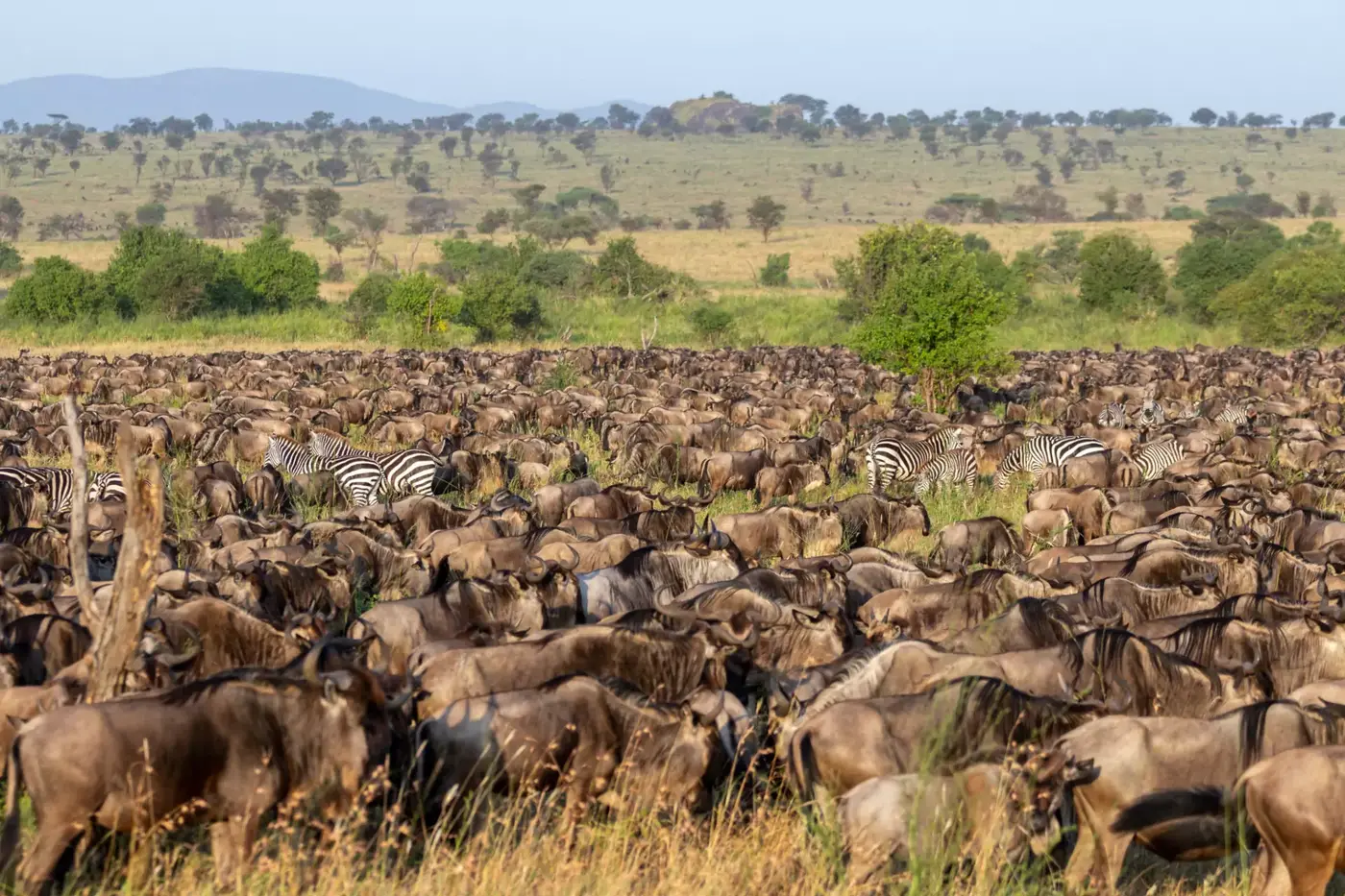
The greatest wildlife show on earth — a migration that never stops moving.
The Great Migration is the year-round movement of roughly two million wildebeest, zebra and gazelle in a vast clockwise circuit through the Serengeti-Mara ecosystem, in search of fresh grazing and water — a movement so significant that the Serengeti is a UNESCO World Heritage Site largely because of it. It is not a single event but a continuous journey, and where the herds are depends entirely on the month.
Its most famous moments are the Mara River crossings — when columns of wildebeest plunge down steep banks through crocodile-filled water — and the calving season, when half a million calves are born in a matter of weeks. The art of a great migration safari is simple: be in the right place, at the right time. That is what we do.

Written by Evance, co-founder of NndeeAfrika
Tanzanian-born, raised beside the Serengeti and fifteen years planning migration safaris — the timings below come from camp reports and our own seasons in the field, not a press release.
The migration, month by month
Use this as your planning guide. Timings shift a little each year with the rains, so we watch conditions closely and place you in the camp best positioned for your exact dates.
The gold marker shows where the herds are in {{ calSel.month }} — pick any month above.
{{ calSel.place }}
{{ calSel.desc }}
Where we'd base you: {{ calSel.base }}
Plan a {{ calSel.month }} migration safariThe migration map, season by season
One and a half million wildebeest move clockwise around the Serengeti–Mara ecosystem every year — roughly 500 miles. Follow the circuit from the calving grounds in the south to the Mara River in the north and back.
{{ r.title }}
{{ r.desc }}
The herds follow the rain, not the calendar — timings shift a few weeks year to year. We track camp reports through the season and place you where the herds actually are, not where the brochure says they should be.
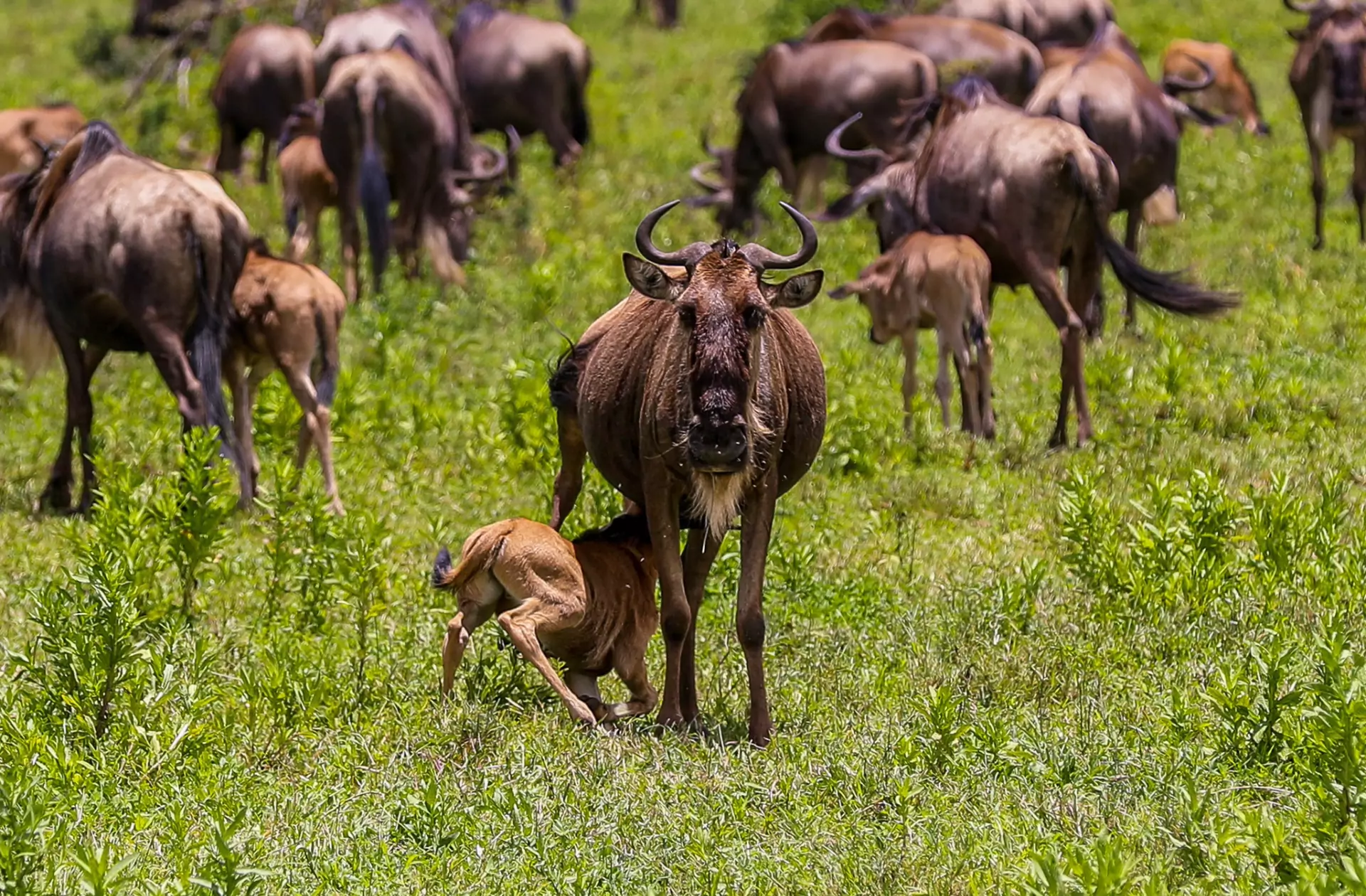
Calving season, the migration's other spectacle
Everyone pictures the river crossings. The travellers who come back a second time usually ask for this instead: around half a million calves born on the short-grass plains of the southern Serengeti in a few weeks, roughly 8,000 of them a day at the peak.
A newborn wildebeest is on its feet within minutes and running with the herd inside an hour — because everything on the plain knows the calves have arrived. Lion, cheetah and hyena work the edges of the nursery herds daily, which makes this the most concentrated predator viewing of the entire year. It is also green season, so the same mobile camps cost a fraction of July.
The most dramatic moment in nature
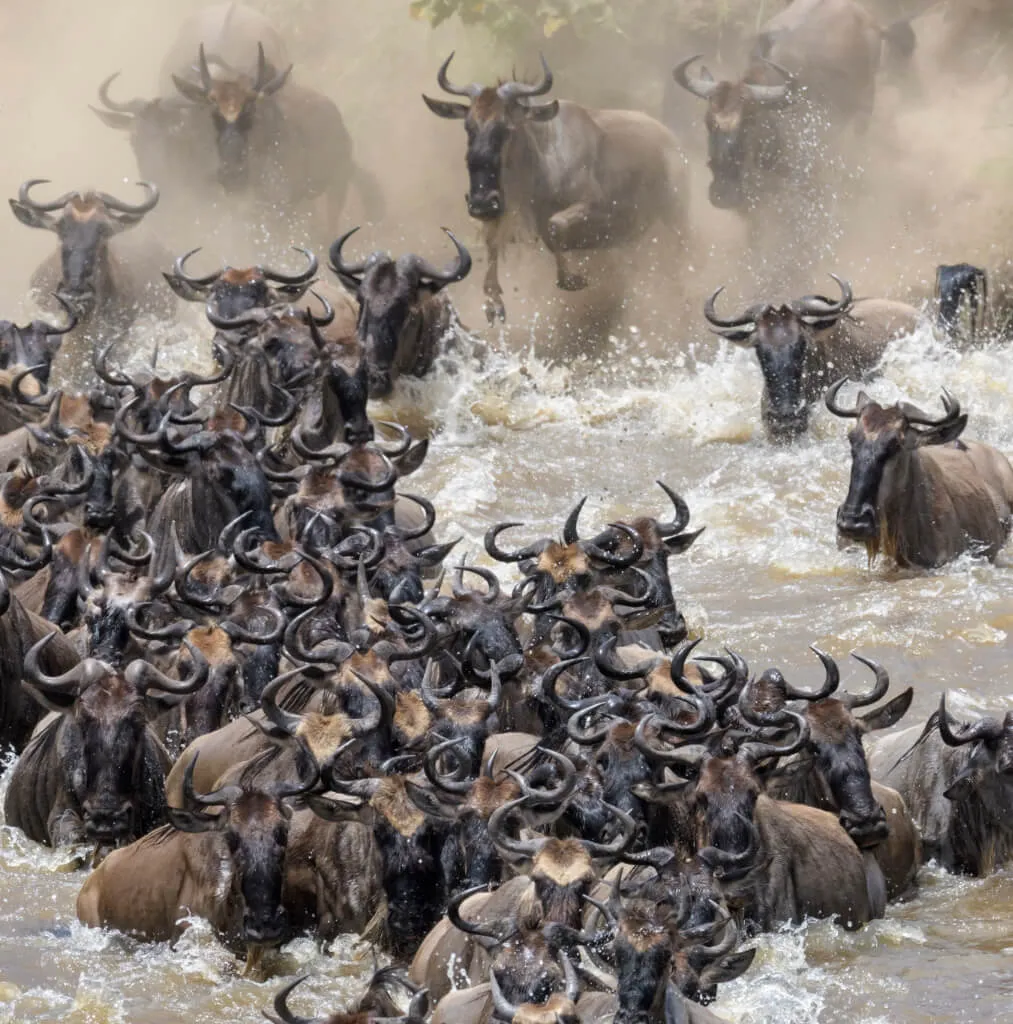
Twice on their circuit the herds must cross water. From May to July they face the Grumeti River in the western Serengeti. From July to October come the legendary Mara River crossings in the northern Serengeti and the Maasai Mara — thousands of wildebeest hurling themselves down the banks past waiting crocodiles.
Crossings are unpredictable: a herd may build at the water's edge for hours, then turn back, or pour across in minutes. The secret is to stay several nights in a riverside camp and let your guide read the herds — patience is rewarded with the spectacle of a lifetime.
May–July · western Serengeti corridor
July–October · northern Serengeti & Maasai Mara
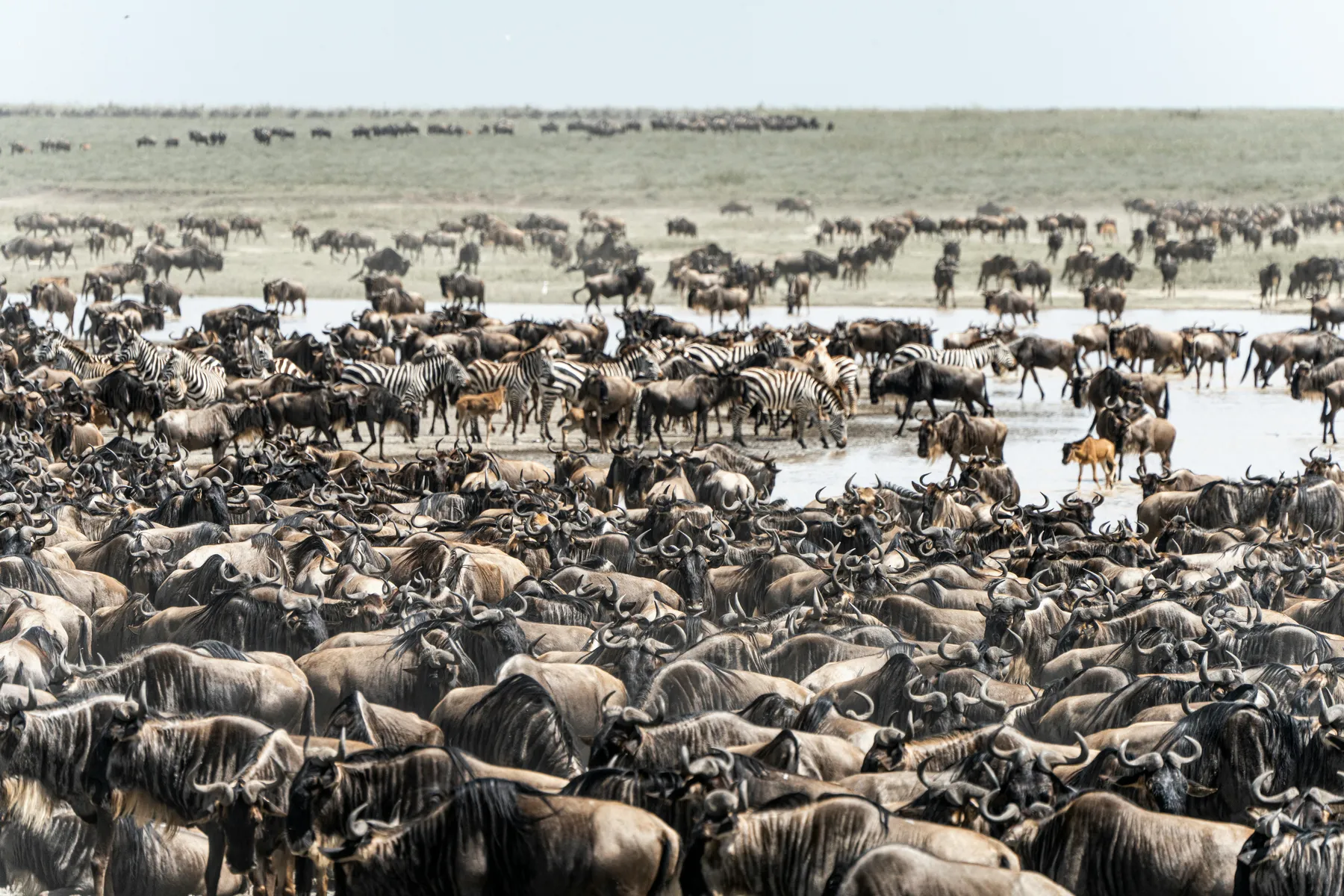
Two countries, one migration
The Serengeti
Home to the herds for most of the year — calving in the south (Jan–Feb), the Grumeti crossings (May–Jul) and the northern Mara River crossings (Jul–Oct). The widest choice of migration camps.
Explore Tanzania → Kenya · Maasai MaraThe Maasai Mara
The stage for the most famous crossings from July to October, when the herds push north out of the Serengeti. Private conservancies offer exclusive, uncrowded viewing.
Explore Kenya →Best time for a Great Migration safari
Peak season — the Mara River crossings in the northern Serengeti and Maasai Mara. The most dramatic and most sought-after window.
Calving season in the southern Serengeti — half a million calves born, and intense big-cat predator action on the plains.
The Grumeti crossings and the rut in the western corridor — fewer travelers and excellent value.
Planning your migration safari
The best riverside camps in crossing season sell out 10–12 months ahead. Secure dates as early as you can.
Allow at least 3–4 nights in the crossing area — crossings can't be scheduled, so time is your best ally.
Fly into Kilimanjaro (JRO) for the Serengeti or Nairobi (NBO) for the Mara; light aircraft reach the migration airstrips.
Private, all-inclusive migration safaris, fully tailor-made to your dates and camps.
Where to stay on a Great Migration safari
The migration moves, so the best camps move with it. These mobile and well-placed camps put you within striking distance of the herds and the river crossings, month by month. Tell us your dates and we'll position you perfectly.
These are a few of our favorites — timing is everything, so we match your camp to where the herds will be. Have a specific camp in mind? Tell us in your enquiry and we'll secure it.
Northern Serengeti or the Maasai Mara?
The two halves of a Great Migration safari are two banks of the same river, ninety minutes apart by air and separated by a border the wildebeest ignore. Which one suits you comes down to what you want the trip to be, so here is how we actually advise it — including when we tell people they have chosen wrong.
The northern Serengeti
Kogatende and Lamai hold a handful of camps between them, some within a few minutes of the water. When a crossing starts you are often watching it with two or three other vehicles rather than thirty, and you can sit at a likely crossing point from dawn until it happens.
✓Fewest vehicles at a sighting of anywhere on the migration
✓Camps close enough to the bank to wait all morning
✓Chains naturally with Ngorongoro and the calving plains
—No off-road driving anywhere inside the national park, and balloons fly the north only from July to October
Choose it if the crossing itself is why you are getting on the plane.
The Maasai Mara
Smaller, greener and thicker with predators — the Mara carries the highest lion density in Africa, and they follow the herds. Stay in a private conservancy rather than the reserve and you gain off-road driving, night drives and walking, none of which the Serengeti permits.
✓Extraordinary predator viewing alongside the herds
✓Hot-air ballooning at dawn over the migration
✓Conservancies allow off-road, night drives and walking safaris
—The public reserve can be busy at a crossing; conservancy camps fix this
Choose it if you want a complete Big Five safari with the crossings as one chapter.
Our honest answer, most of the time: do both. A single bush flight moves you between them, and having camps on either bank roughly doubles the number of mornings you can be at the river. That is precisely what our eleven-day migration itinerary is built to do.
Pick-up from camp in the dark, inflation at first light, then breakfast laid out wherever you happen to land.
Aloft, weather depending — but four hours door to door once the drive and the champagne breakfast are counted.
Per person over the Serengeti for the 2026 season; northern launch sites carry a premium, and the Maasai Mara runs nearer $450–550. Included in no safari price anywhere — we add it to your quote.
Where it actually flies
The Serengeti has four launch areas, each on its own calendar: the central Serengeti around Seronera all year, Ndutu from late December to mid-March for calving, the western corridor June to October, and the northern Serengeti July to October — so you can fly over the river country in crossing season, at a premium on the standard fare.
In Kenya the Maasai Mara flies daily and year-round over the migration country itself, for rather less money. A balloon is possible on either side, then — the only question is which morning of your route we place it on, and we will tell you which leg gives the better view for your month.
We book direct with the licensed concession holders rather than through resellers, so the seat is confirmed before you pay and the transfer is timed to your camp rather than a coach schedule.
Whether we recommend it
Usually yes, once — and not on a tight budget, where the same money buys another night beside the river, which for pure wildlife odds is the better purchase. It also costs you that morning's game drive, so it suits people who do not mind a 4am alarm.
Book it with the trip, not on arrival. For June to October the baskets go six to nine months ahead; January to March is easier at two or three. A shared basket takes up to sixteen, and private balloons need a minimum of two.
—Children under seven are not carried; from seven to sixteen, child rates sometimes apply
—There is an upper weight limit, generally 120kg, and it is enforced for balance
—You climb in and out of a chest-high basket, so it does not suit impaired mobility
—Flights are weather-dependent; cancellations are rare but happen, and you are refunded
How you actually get there
Almost every Great Migration safari ends with a light aircraft off a dirt strip — the river country is remote. None of it is difficult — but it is the part travellers are told least about, and it shapes what you should pack.
The long flight
Kilimanjaro (JRO) for the Serengeti, Nairobi (NBO) for the Mara. From the US that is usually one stop through Amsterdam, Doha, Istanbul or Addis. We advise on routing and timing but leave the ticket to you, so you can spend miles or keep your own airline — then we build the ground around whatever you book.
The bush flight
A twelve-seat Cessna to a strip in the grass — Kogatende for the northern Serengeti, Seronera for the centre, Ndutu for calving season. Shared flights make two to four stops on the way, and departure times are confirmed only the evening before, in camp. It is the most beautiful hour of the trip: you see the herds as lines from the air before you ever meet them.
A soft bag, and only one
Light aircraft allow between 15kg and 20kg per person including hand luggage and cameras, and the bag must be soft-sided — the belly pods are only 25cm high, so a wheeled hard case will not go in. Camps launder daily, which is why a week needs far less than people bring. Our packing list is built around exactly this limit.
Crossing the border
Doing both sides means an air transfer between Kogatende and the Mara, clearing immigration at a small airstrip post. It takes minutes rather than hours, and we handle the permits and the paperwork — but your passport needs six months’ validity beyond your return and three blank pages.
What a migration safari costs
Most operators will not put a number on a page. We will, because you deserve to know whether to keep reading. Every trip is priced individually, but these are the bands our migration travellers actually land in — per person, all-inclusive on the ground, excluding international flights.
Green season, one side
Seven to eight nights in calving season, good tented camps, one country. February at its best for far less than August.
Crossing season, done properly
Where most of our migration travellers sit. Ten nights in peak season with riverside camps in the north and enough mornings to wait for a crossing.
Both banks, private vehicle
Serengeti and Mara, a private guide and vehicle throughout, a conservancy for the off-road driving, and a balloon at dawn.
Exclusive-use and charter
A camp taken over for your family, private charters instead of shared flights, a photographic guide travelling with you.
Season first, and by a wide margin — the same camp can be half the price in March that it is in August. Then how close to the river you sleep, whether your vehicle is private or shared, and how many bush flights the route needs. Two travellers sharing pay considerably less each than one travelling alone.
Every camp named night by night, all internal flights and transfers, park and conservancy fees, meals and game activities, airport meet-and-greet, and our own line to you while you travel. International flights, visas, insurance and gratuities sit outside it — always listed, never buried. See exactly what a quote contains.
Continue exploring
Serengeti safaris
The home of the migration, plus the Ngorongoro Crater and Zanzibar.
Explore Tanzania → KenyaThe Maasai Mara
The northern stage of the migration and Kenya's finest big-cat country.
Explore Kenya → The regionEastern Africa
Combine the migration with gorillas, the Big Five and the islands of Zanzibar.
Explore the region →Great Migration FAQs
{{ faq.a }}
Be there for the
crossing.
Tell us when you can travel and our specialists will place you in the right camp at the right moment — no obligation.
Plan your migration safari