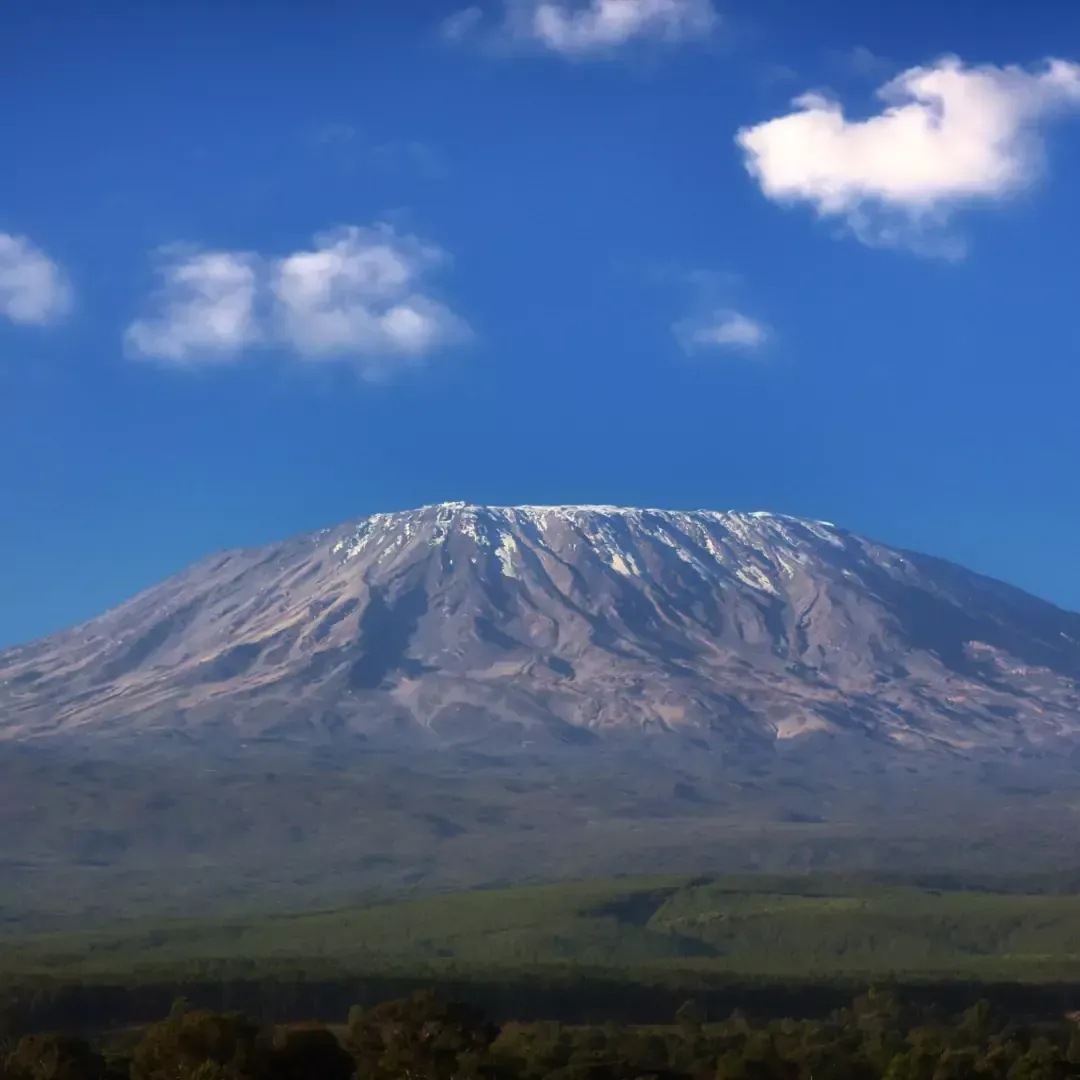
Mount Kilimanjaro rises 5,895 meters (19,341 feet) above northern Tanzania — Africa’s highest mountain and the tallest free-standing mountain on earth. A dormant volcano of three cones (Kibo, Mawenzi and Shira), it carries its famous glaciers just three degrees south of the equator.
Climbing to Uhuru Peak is a bucket-list trek that needs no technical skill — but the mountain rewards non-climbers too. Its snows float above the acacia plains of Amboseli and the coffee farms of the Chagga homeland, and Kilimanjaro National Park protects everything above the cultivated foothills: a UNESCO World Heritage Site since 1987.
Highlights of Mount Kilimanjaro
Five climate zones
One climb passes from rainforest through heather, moorland and alpine desert to arctic summit ice.
Uhuru Peak — 5,895m
The roof of Africa, reached at sunrise after a starlit summit night.
Explore Uhuru Peak — 5,895m →The Chagga foothills
Coffee farms, waterfalls and village life on the mountain’s fertile lower slopes — Evance’s home ground.
Explore The Chagga foothills →The classic view
Elephants beneath the snows — photographed best from Amboseli, across the Kenyan border.
Explore The classic view →Best time to climb Kilimanjaro
Warm, clear and quieter on the routes — with a chance of fresh summit snow.
The long dry season — the most popular and reliable climbing window.
In the green months rates ease at many of these camps, the plains empty of vehicles and the light turns dramatic. What each season gives, and what it trades, is set out in our Safari Planning Guide.
Planning & cost
Fully tailor-made — priced privately to your camps, season and travel style. No fixed packages.
Every journey is privately designed, with private guides and vehicles arranged where specified, the finest lodges, and a specialist on call throughout. At fly-in camps, game drives may be shared unless a private vehicle is reserved.
Climbing it, or simply seeing it
Most climbers choose a route of seven or eight days, because time to acclimatize is what gets people to the summit. Longer routes such as the Lemosho approach from the west allow a gradual ascent, and our Lemosho route itinerary shows how the days fall. Every climb is led by licensed mountain guides with a porter team, and summit night starts around midnight to reach Uhuru Peak near sunrise. Our Kilimanjaro trekking page covers the routes in detail.
You do not need to climb to enjoy the mountain. On the lower slopes around Moshi, Chagga families grow coffee and bananas in shaded home gardens, and a day in the foothills can include a coffee farm, a waterfall walk and a village lunch. Evance is Chagga and grew up on these slopes, so this is the part of Tanzania we know most personally.
Kilimanjaro also pairs naturally with a safari. Kilimanjaro International Airport is the gateway to northern Tanzania, so a climb can finish in Tarangire, the Ngorongoro Crater and the Serengeti, or with a few days on Zanzibar.
Practical details,
in one place
Money, health, connectivity and packing work the same way on every safari we plan, so they live in one place rather than on every page.
Continue exploring
Kilimanjaro Trekking
A Kilimanjaro trek takes you to the roof of Africa — 5,895m above the Tanzanian plains.
Explore → Eastern AfricaTanzania
The Serengeti, Ngorongoro Crater, Tarangire and Zanzibar.
Explore → KenyaAmboseli National Park
Amboseli — great tuskers beneath the snows of Kilimanjaro.
Explore → RegionEastern Africa
The Great Migration, the Rift Valley and the gorillas — Tanzania, Kenya, Rwanda and Uganda.
Explore →Mount Kilimanjaro FAQs
Getting to Tanzania — flights, visas and health
Current at the time of writing. We re-confirm every requirement for your exact routing before you travel — and we will tell you what to apply for, and when.
Let's design your Mount Kilimanjaro journey.
Mount Kilimanjaro is best climbed with time to spare and a route chosen for acclimatization.
Tell us how you like to travel and start with a complimentary consultation. When you are ready, a $500 USD planning fee covers your personalized itinerary and revisions, and is deducted from your booking deposit when you book.
Inquire now