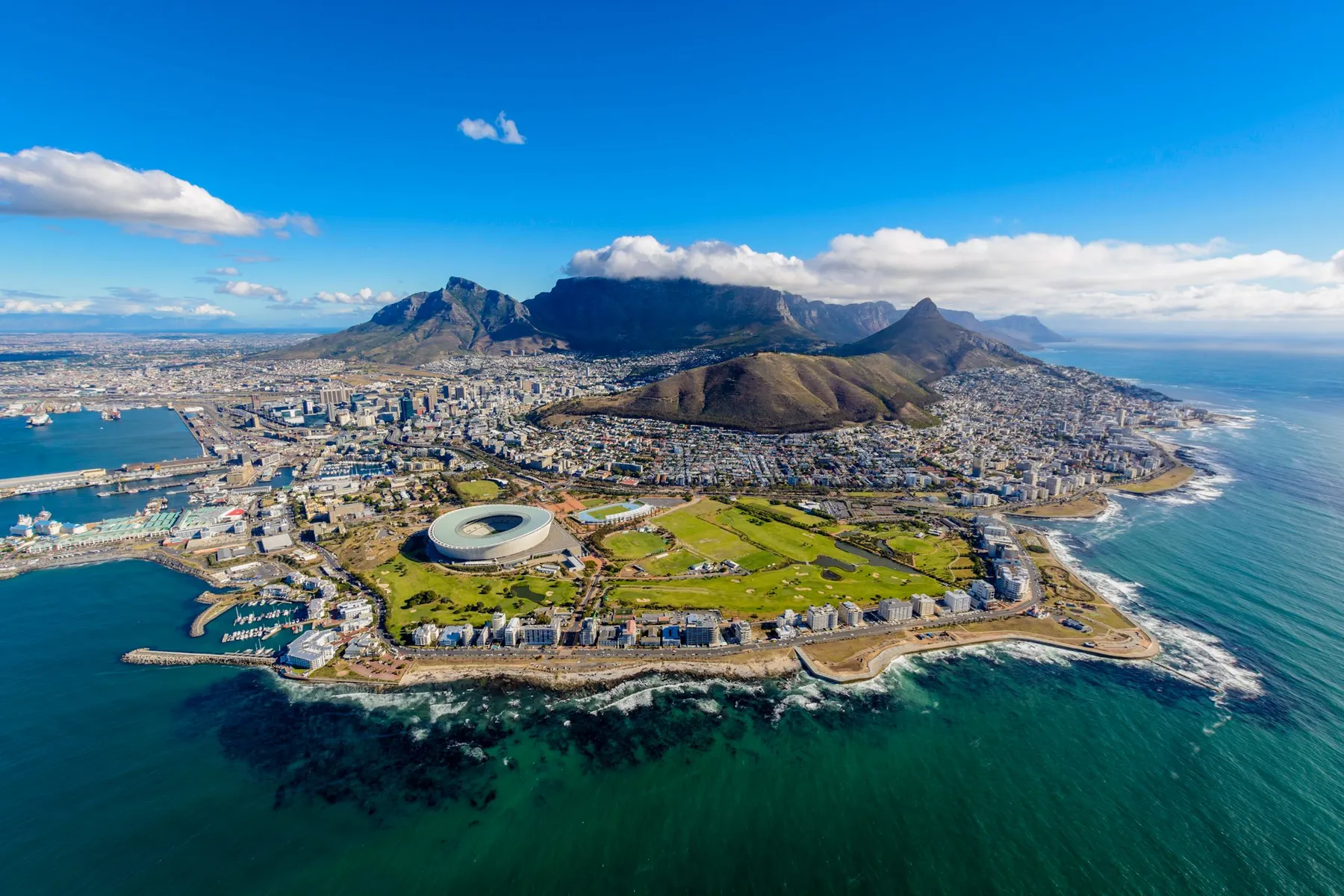
Few cities on earth sit in a setting like this — Table Mountain rising straight out of the Atlantic, beaches on one side, vineyards on the other. After the early mornings and dust of the bush, Cape Town is where a South Africa journey exhales: long lunches, sea air and some of the best food and wine anywhere.
An hour east lie the Cape Winelands — Stellenbosch and Franschhoek — where 300-year-old estates pour world-class vintages beneath the mountains. Most of our South Africa journeys pair three or four nights here with the Sabi Sand: Big Five in the morning, fine dining by the weekend.
Highlights of Cape Town & the Winelands
Table Mountain
Ride the cableway or hike up — the view over the city and both oceans is unmatched.
The Cape Peninsula
A day’s drive past Camps Bay and Chapman’s Peak to the penguins at Boulders Beach and Cape Point.
The Winelands
Stellenbosch and Franschhoek — historic estates, tastings and celebrated restaurants.
Robben Island & history
The ferry to Nelson Mandela’s former prison, guided by former inmates.
Where you’ll stay in Cape Town & the Winelands
Where you stay is selected privately around your journey. We recommend each camp, lodge or villa according to its location, season, guiding, privacy and suitability for the people traveling. Your carefully curated selection will be presented within your tailor-made itinerary.
Plan your private safariKnow before you go
The practical details we handle for you — flights, entry, health and money — summarized here so nothing surprises you. Requirements can change, so we confirm everything when you book.
United and Delta fly nonstop from Newark and Atlanta to Cape Town (about 15 hours), or connect through Johannesburg. From the Sabi Sand reserves it is a two-hour scheduled flight.
US citizens visit South Africa visa-free for up to 90 days; passport valid six months beyond travel with at least two blank pages. New from July 2026: all travelers entering or leaving South Africa must submit a free online SARS Traveler Declaration (sars.gov.za or the SATMS app) within 24 hours before the departure of their final direct travel leg — we send you the link and walk you through it. International transit passengers who remain within the designated transit area and do not formally enter South Africa are excluded (official SARS guidance). Travelers are not denied entry or departure solely for not having declared beforehand — SARS officials and self-service terminals assist on arrival — but completing it in advance avoids delays. Download our SARS Traveler Declaration guide (PDF).
Complete the SARS declaration ↗Cape Town and the Winelands are malaria-free — no prophylaxis needed for this leg. Tap water is safe to drink.
The US dollar goes far against the rand. Cards are accepted almost everywhere; tipping is at your discretion — around 10–15% in restaurants.
Best time to visit Cape Town
Cape summer — warm, dry beach and vineyard weather. December–January is peak season.
Shoulder months — mild, quieter and beautiful light. Whales appear from July to November.
In the green months rates ease at many of these camps, the plains empty of vehicles and the light turns dramatic. What each season gives, and what it trades, is set out in our Safari Planning Guide.
Planning & cost
Fully tailor-made — priced privately to your camps, season and travel style. No fixed packages.
Fly into Cape Town International (CPT). The city pairs naturally with the Sabi Sand — a two-hour direct flight — and with a beach finish in Mauritius or Mozambique.
Every journey is privately designed, with private guides and vehicles arranged where specified, the finest lodges, and a specialist on call throughout. At fly-in camps, game drives may be shared unless a private vehicle is reserved.
Practical details,
in one place
Money, health, connectivity and packing work the same way on every safari we plan, so they live in one place rather than on every page.
Continue exploring
South Africa
A South Africa safari pairs Big Five private reserves with Cape Town and the Winelands.
Explore → South AfricaKruger & the Sabi Sand
Kruger & Sabi Sand — arguably the world’s finest leopard viewing, in some of Africa’s most polished lodges.
Explore → Beaches & IslandsMauritius
A Mauritius vacation means turquoise lagoons, luxury resorts and championship golf.
Explore → RegionSouthern Africa
The desert, the delta and the falls — Botswana, Namibia, Zambia, Zimbabwe and South Africa.
Explore →Cape Town & the Winelands FAQs
Getting to South Africa — flights, visas and health
Current at the time of writing. We re-confirm every requirement for your exact routing before you travel — and we will tell you what to apply for, and when.
Let's design your Cape Town & the Winelands journey.
Cape Town luxury travel pairs easily with a safari, and works best with a few unhurried days on either side.
Tell us how you like to travel and start with a complimentary consultation. When you are ready, a $500 USD planning fee covers your personalized itinerary and revisions, and is deducted from your booking deposit when you book.
Inquire now